
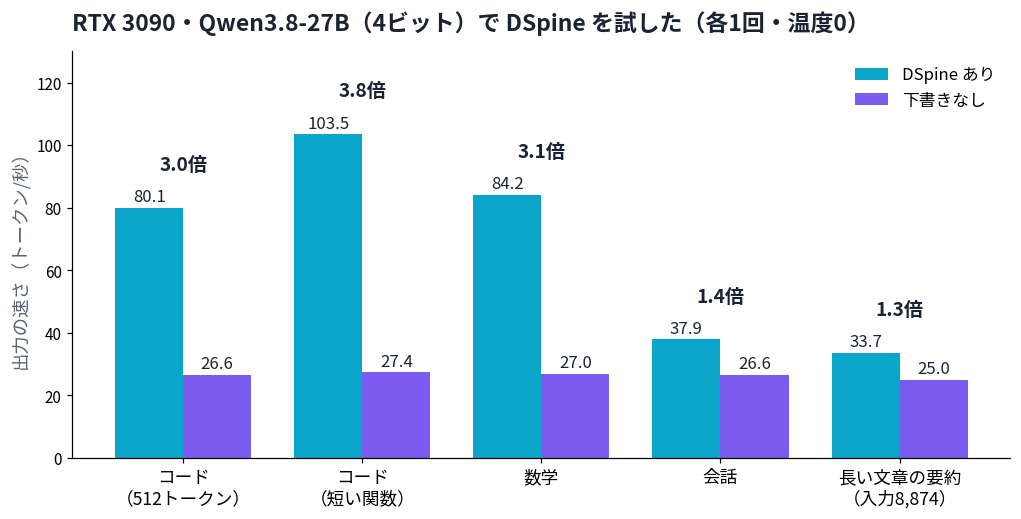
Tencent released the draftsmanship model "DSpin" for speculative decoding (one of the methods to increase inference speed), and we measured its effects with a single consumer-grade RTX 3090. To conclude first, the output speed increased by approximately 3.0 to 3.8 times in code and mathematics, but only by approximately 1.3 to 1.4 times in conversation and summarization of long texts. The magnitude of speedup varies significantly depending on the topic.
What is DSpine?
Speculative decoding is a mechanism in which a small, fast "draftsman" model predicts multiple tokens (character string units finer than words) in advance, which are then collectively verified by a larger main model. Since the main model adopts only the correct candidates, the quality of the answer is determined by the main model. Incorrect predictions are discarded and retried, so the method becomes faster the more accurately the draftsman predicts the topic.
DSpine is this draftsman model. It creates 16-token drafts in parallel and passes features predicted by each layer to the adjacent position, allowing token connections to be handled across layers. Details are available at Tencent/DSpine (GitHub) and the paper (arXiv 2609.36173). In October 2026, the paper, inference code, and support for Qwen3-8B were released, followed by support for Qwen3.8-27B and Apple Silicon in November. The draftsman for Qwen3.8-27B is distributed as 5 layers with Apache-2.0 weights.
The basic concept of speculative decoding and our measurements using another draftsman, DFlash2, are summarized in Current State of Local LLMs Part 5, while the background of decoding bottlenecks caused by memory reads is covered in Part 4. Reading these alongside this article will help clarify the context of the numbers presented here.
Testing on RTX 3090
Measurements were conducted on November 9, 2026, with one trial per condition. The hardware used was a single RTX 3090 (24GB), a consumer-grade GPU.
Regarding software, llama.cpp does not yet support DSpine, so we used a fork of llama.cpp modified by independent developer AJ to include DSpine support (GitHub). The draftsman weights were converted by AJ from Tencent’s weights to 4-bit for llama.cpp (Hugging Face, 1.26GB). The main model used was the 4-bit version of Qwen3.8-27B (unsloth’s UD-Q4_K_M, 16.5GB). We thank AJ for making the software fork and converted weights publicly available; it would have been difficult for us to replicate these exact conditions on our own.
Settings included a context of 32,768, 8-bit KV cache (memory to hold conversation history), up to 15 tokens for drafting, a temperature of 0 (settings that return the same answer for the same question), thinking disabled, and a maximum output of 512 tokens.
Results
Output speed is shown in tokens/second. "With DSpine" indicates when the draftsman was used, "No draft" indicates when it was not, and "Ratio" is the ratio of the former to the latter.
| Topic | With DSpine | No Draft | Ratio |
|---|---|---|---|
| Code (LRU cache class and test, 512 tokens) | 80.1 | 26.6 | approx. 3.0x |
| Code (short function, 98 tokens) | 103.5 | 27.4 | approx. 3.8x |
| Mathematics (step-by-step solution of quadratic equations, 512 tokens) | 84.2 | 27.0 | approx. 3.1x |
| Conversation (one-day tour of Tokyo, 512 tokens) | 37.9 | 26.6 | approx. 1.4x |
| Summarization of long text (input 8,874 tokens, output 64) | 33.7 | 25.0 | approx. 1.3x |
In the summarization of long texts, the input reading speed was 1,089 / 1,085 tokens/second, showing no change regardless of the presence of DSpine.
Where it works and where it doesn’t
The differences in performance are reflected in how many draft candidates were accepted. In mathematics, 409 out of 1,522 candidates were accepted. In contrast, in conversation, only 284 out of 3,345 candidates were accepted, indicating a high rejection rate. Our measurements suggest that code and mathematics are easier to predict because their subsequent developments are somewhat predictable, while conversation is free-flowing and harder to guess.
VRAM usage was approximately 20.8GB with DSpine and approximately 16.5GB without it. This means the draftsman and its processing consume about 4.3GB of the 24GB capacity. On a 24GB card, headroom between the main model and the draftsman is reduced, so caution is needed when handling longer contexts or larger models on the same card.
With a temperature of 0, the outputs were identical with and without DSpine. As designed, the draftsman affects only speed, while the main model determines the actual answer.
Tencent’s evaluation and AJ’s report
Tencent evaluated under conditions of SGLang, BF16, and 8 concurrent requests. Agent task speeds were 2.71 to 3.84 times faster than without drafting, while the competitor DFlash2 was 2.33 to 3.17 times faster. The length of accepted sequences was notably longer in mathematics (GSM8K 7.20, DFlash2 5.69) and shorter in conversation (MT-Bench 4.48, 4.11). The values are available on the page for the draftsman for Qwen3.8-27B.
In a post on X (2026-11-09), AJ reported using the same RTX 3090, achieving approximately 125 tokens/second (4.5 times faster than no draft) in code and mathematics, approximately 90 (3.2 times faster) in mixed conversation, and 31.1 in a 32k context for novel text (compared to 23.8 for no draft).
Our numbers and AJ’s numbers differ in both topic and settings, so direct comparison to declare superiority is not possible. However, the trend of significant gains in code and mathematics and smaller gains in conversation and long texts is consistent across both. Considering also Tencent’s evaluation, all three sets of conditions differ, so we believe it is appropriate to interpret only the consistent trends.