
Controlling quantum computers: The Exchange-only qubit achieves universal computation using only the "exchange interaction" between spins, without any magnetic field pulses.
The biggest challenge with this device is that its physical control axes are not orthogonal to the logical operation axes (X, Y, Z).
We previously learned how to choose a basis.
【Contribution】How Exchange-Only Qubits Work: Surpassing "Magnetic Fields" with 3 Spins
This time, we will explain in detail from the definition of the singlet-triplet basis for a three-spin system to the synthesis process of the logical X gate using tetrahedral geometry.
1. Review of Previous Content: Basis States and Exchange Hamiltonian
In an exchange-only qubit, the space with total quantum number \(S=1/2\) and magnetization quantum number \(M_s=1/2\) for three electron spins is used as the logical space. This space is spanned by the following two bases depending on the states of spin 1 and 2.
Definition of Basis States (Singlet-Triplet)
Physical exchange interaction is based on the Hamiltonian \(H_{ij} = J_{ij} (\mathbf{S}_i \cdot \mathbf{S}_j)\). The logical basis referenced to the state of the spin 1 and 2 pair is as follows.
Singlet basis (Logical \(|0\rangle\)): A state where spins 1 and 2 form an anti-parallel pair
Triplet basis (Logical \(|1\rangle\)): A state where spins 1 and 2 form a parallel pair, forming an overall \(S=1/2\)
Matrix Representation of Exchange Interaction
In this basis, the exchange operations \(H_{12}\) and \(H_{23}\) between adjacent spins are described as combinations of the following Pauli matrices.
Spin 1-2 Exchange: It is the logical Z-axis itself
Spin 2-3 Exchange: An axis tilted 120 degrees from the Z-axis
An important constraint becomes clear here. While \(H_{12}\) is a rotation around the vertical axis (\(Z\)-axis) of the Bloch sphere, \(H_{23}\) is a rotation around an axis \(n\) tilted \(120^\circ\) from the \(Z\)-axis. There is no physically existing orthogonal \(X\) handle; we are always forced to cut the handle at an angle.
2. Synthesis of Logical X Gate: Tetrahedral Geometry
To create a pure \(X\) gate (\(180^\circ\) inversion), it is necessary to cleverly combine this "120-degree axis" with the "vertical axis." Here, we utilize the geometric properties of a regular tetrahedron whose vertices lie within the Bloch sphere.
3-Step Sequence for Gate Synthesis
Using the physical \(n\) axis (right side) and the \(Z\) axis (left side), continuous rotations are performed at the following angles.
First, let's confirm the tetrahedron and the axes.
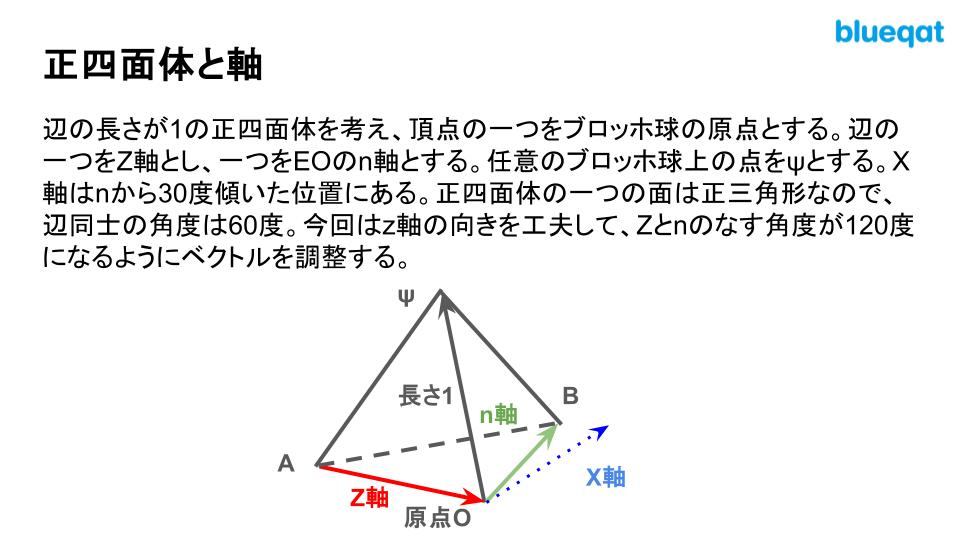
Consider a regular tetrahedron with edge length 1, with one vertex at the origin of the Bloch sphere. One edge serves as the Z-axis, and another as the EO n-axis. Let any point on the Bloch sphere be \(\psi\). The X-axis is located at a position tilted 30 degrees from n. Since one face of the regular tetrahedron is an equilateral triangle, the angle between edges is 60 degrees. This time, we adjust the vectors so that the angle between Z and n becomes 120 degrees by manipulating the direction of the Z-axis.
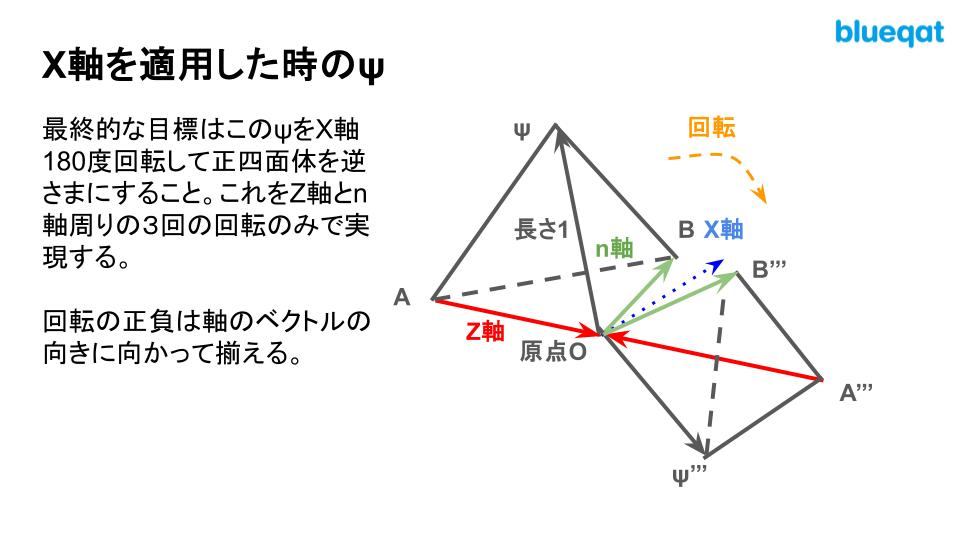
Let's check the final quantum state after applying the X-axis.
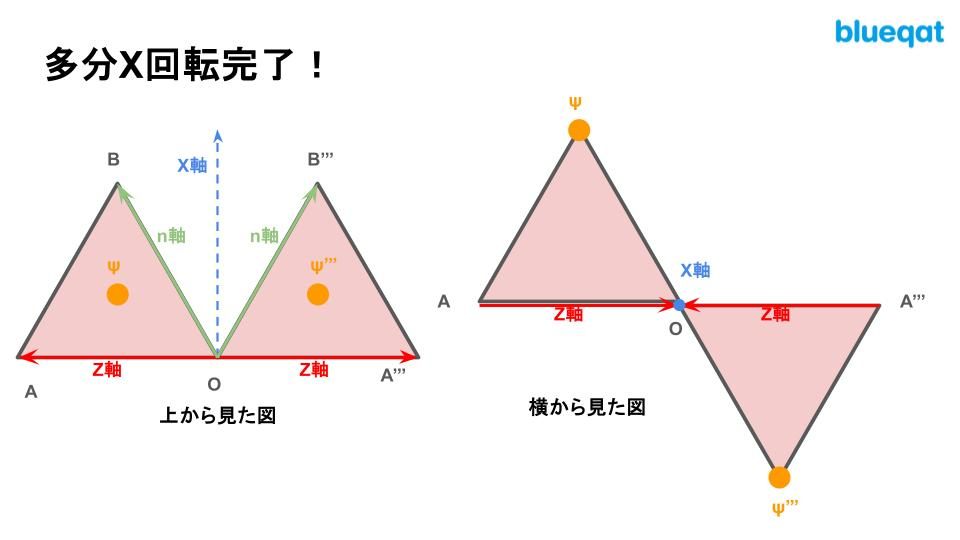
The final goal is to rotate \(\psi\) by 180 degrees around the X-axis to turn the tetrahedron upside down. We achieve this using only three rotations around the Z-axis and the n-axis. The signs of rotation are aligned toward the direction of the axis vectors.
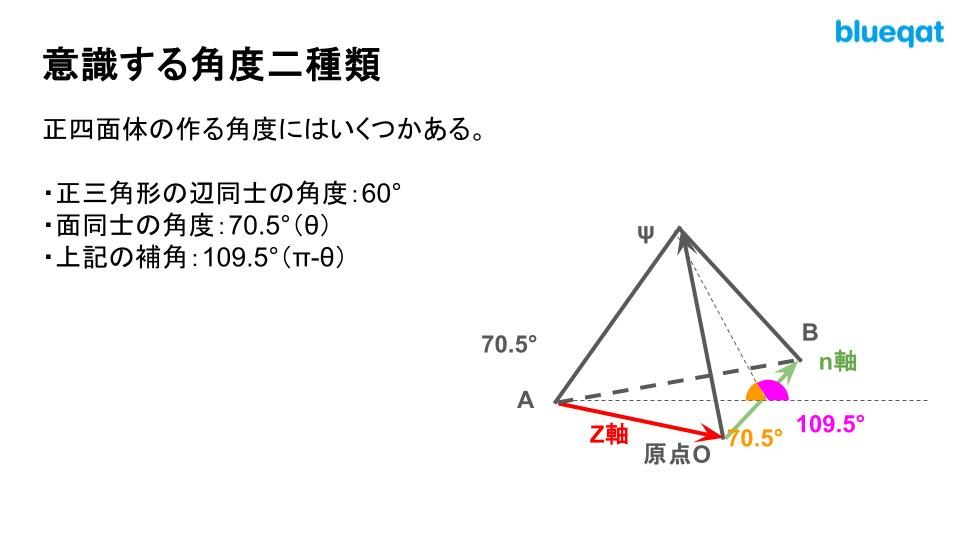
Here is a review of the angles of the upcoming tetrahedron.
There are several angles formed by a regular tetrahedron.
· Angle between edges of an equilateral triangle: 60°
· Angle between faces: 70.5° (\(\theta\))
· Supplementary angle of the above: 109.5° (\(\pi-\theta\))
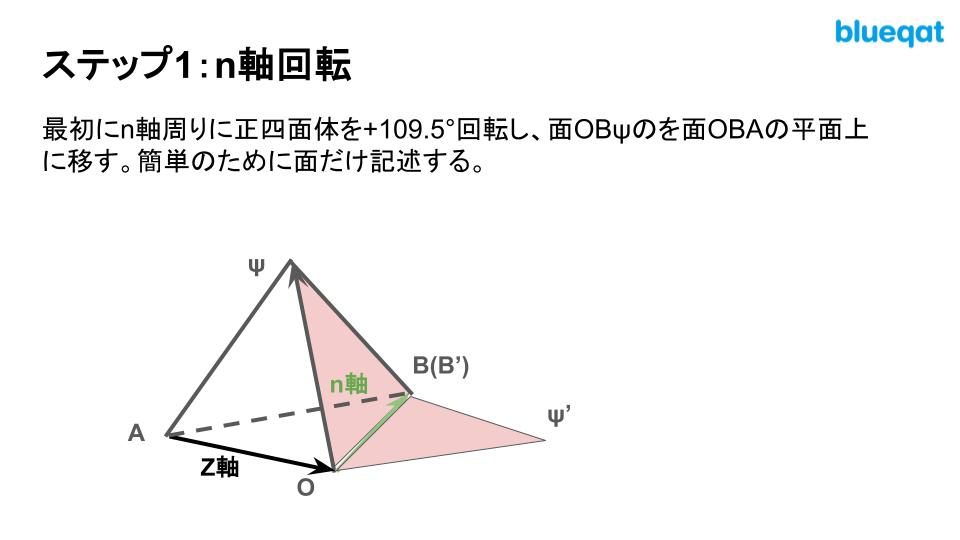
Step 1: Rotation around the n-axis
First, rotate the tetrahedron by +109.5° around the n-axis to move the plane OB\(\psi\) onto the plane OBA. For simplicity, only the planes are described.
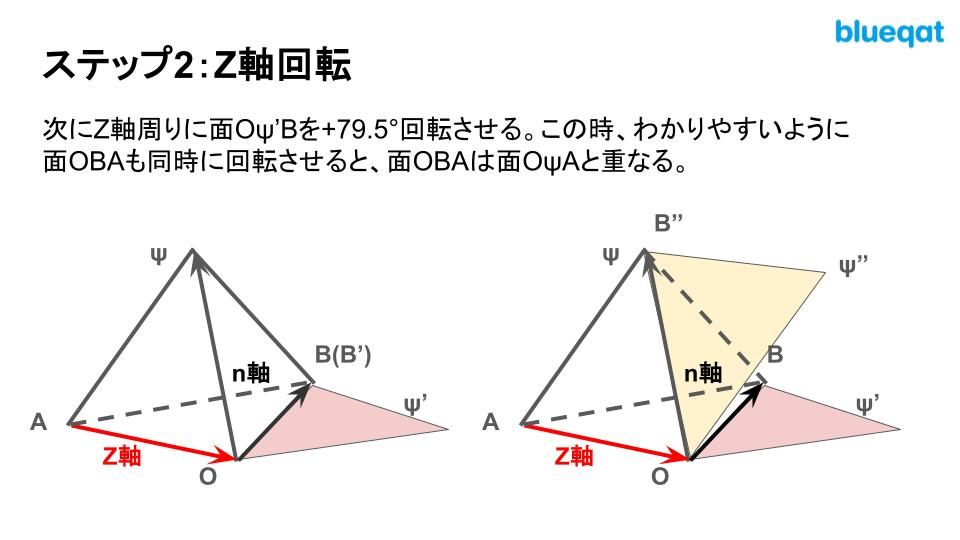
Step 2: Rotation around the Z-axis
Next, rotate the plane O\(\psi'\)B by +79.5° around the Z-axis. At this time, if you also rotate the plane OBA for clarity, the plane OBA overlaps with the plane O\(\psi\)A.
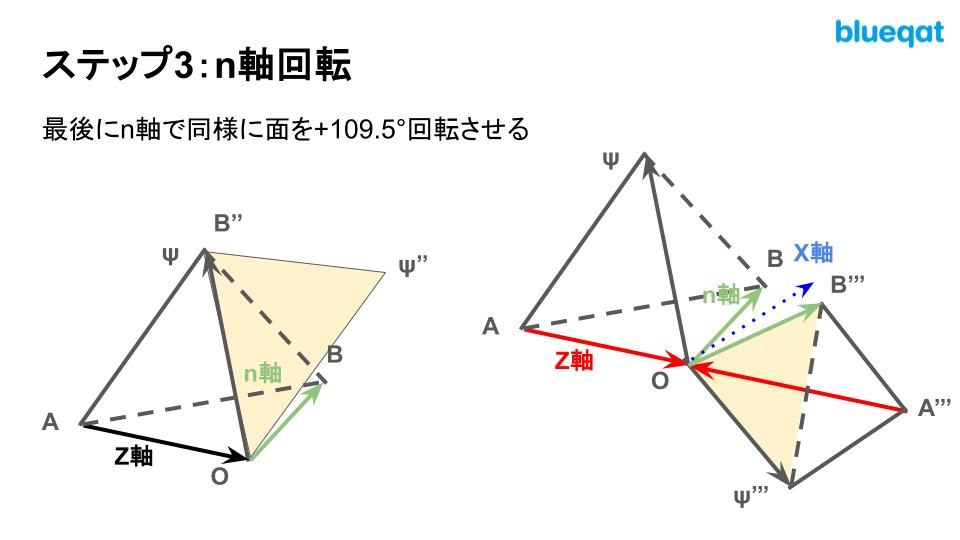
Step 3: Rotation around the n-axis
Finally, similarly rotate the plane by +109.5° around the n-axis.
X Rotation Complete!
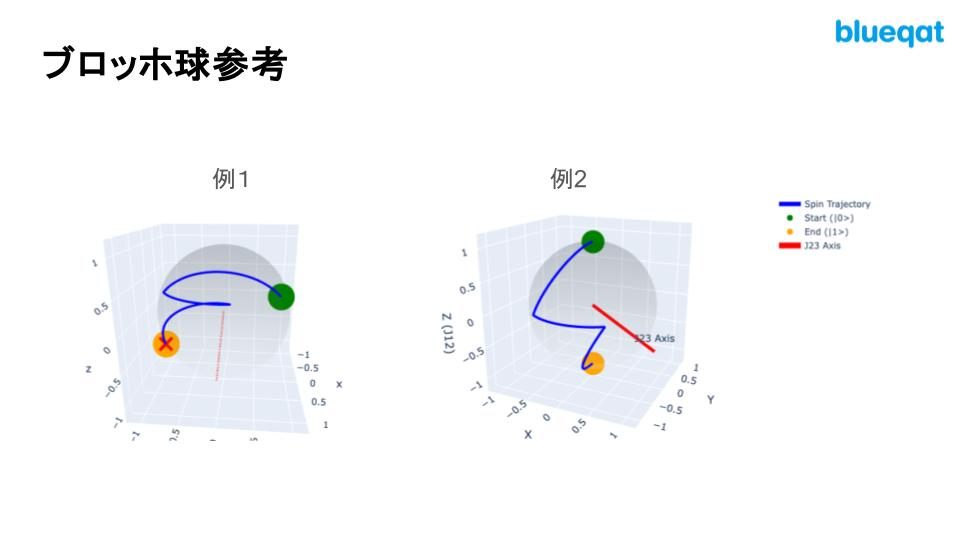
This shows the trajectory drawn on the Bloch sphere when a randomly set quantum state is rotated by X.
Due to this specific combination of angles, the result of the composite rotation mathematically matches \(e^{-i \frac{\pi}{2} \sigma_x}\), which is a pure logical X gate.
3. Visualization via Simulation Video
The following video visualizes this "extraction of X from constrained axes."
https://x.com/MinatoYuichiro/status/2018904777925779857?s=20
Conclusion: Elegance Born from Constraints
The logical X in an exchange-only qubit is not just a pulse, but a process akin to "sculpting" that utilizes the symmetry of a regular tetrahedron. Understanding this process is nothing other than touching the essential beauty of quantum operations.
With the establishment of this logical X, Hadamard gates and logical Y can also be freely implemented as combinations of similar geometric paths.
References
Three-electron spin qubits
https://iopscience.iop.org/article/10.1088/1361-648X/aa761f
Universal logic with encoded spin qubits in silicon
https://www.nature.com/articles/s41586-023-05777-3