
To achieve this:
- Output only the translation. Do not add prefaces, explanations, or annotations.
- Do not add words, evaluations, or reasons not present in the original text. Do not omit content from the original text.
- Keep numbers, units, dates, proper nouns, ticker symbols, company names, and product names exactly as they are (do not change any numbers).
- Preserve Markdown formatting such as headings, bullet points, and tables.
- For the {{link:number|display text}} syntax, keep the number as is and translate only the display text.
- For [text](URL) links, keep the URL as is and translate only the text.
Text to translate (article body):
A demonstration was conducted by blueqat to schedule room cleaning and staff shifts using a quantum algorithm for a resort located on the coast of Onna Village, Okinawa. A digital twin (a virtual representation of real facilities and human movements) that replicated an entire 204-room hotel inside a computer was used to simulate one day’s operations and compared with current methods. On a busy sunny day, operational burden—measured by delays, overtime, and other factors converted into minutes—was reduced by 21%. Using a quantum gate algorithm, which has been said to solve only small problems, the same scale of problem as classical computing was solved, yielding answers equivalent to those from classical computing.
The setting is the fictional resort "Onna Coral Terrace"
The setting is the fictional resort "Onna Coral Terrace," placed on the actual coastline of Onna Village (OpenStreetMap).
- Main building: 8 floors × 24 rooms and 12 villas, totaling 204 rooms
- Staff: 22 cleaners, 3 inspectors, 2 runners, 1 laundry worker
- Weather data: Hourly values from Nago, obtained from the Japan Meteorological Agency (actual observed values)
Reservations, staff, and events are fictional, but the weather data is real.
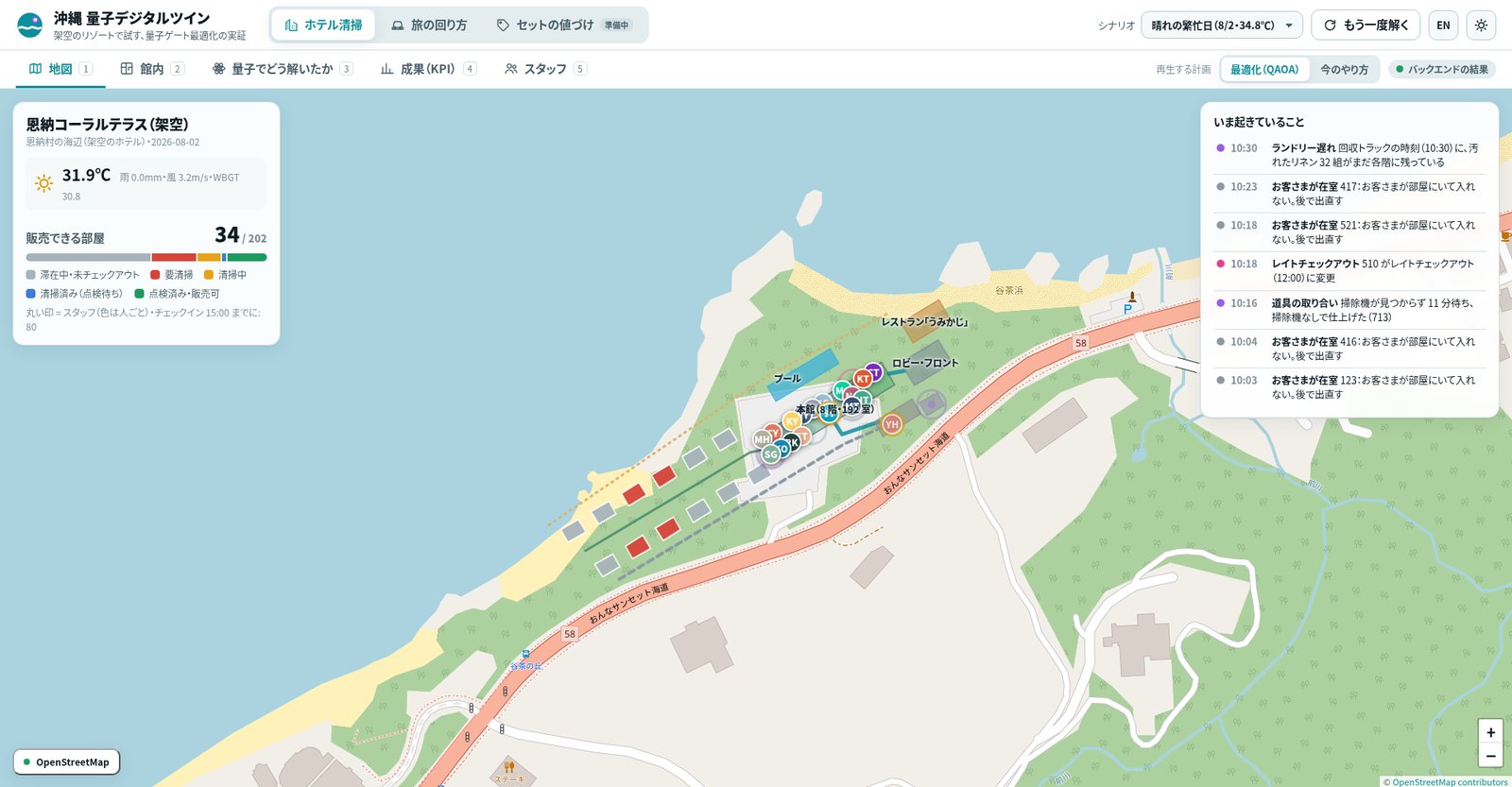
The digital twin includes each staff member’s speed, compatibility, fatigue, the number of carts and vacuum cleaners, one service elevator, heat, wind and rain, occupancy of guests staying multiple nights, late checkouts, and re-inspections. 28 people move in 0.25-minute increments.
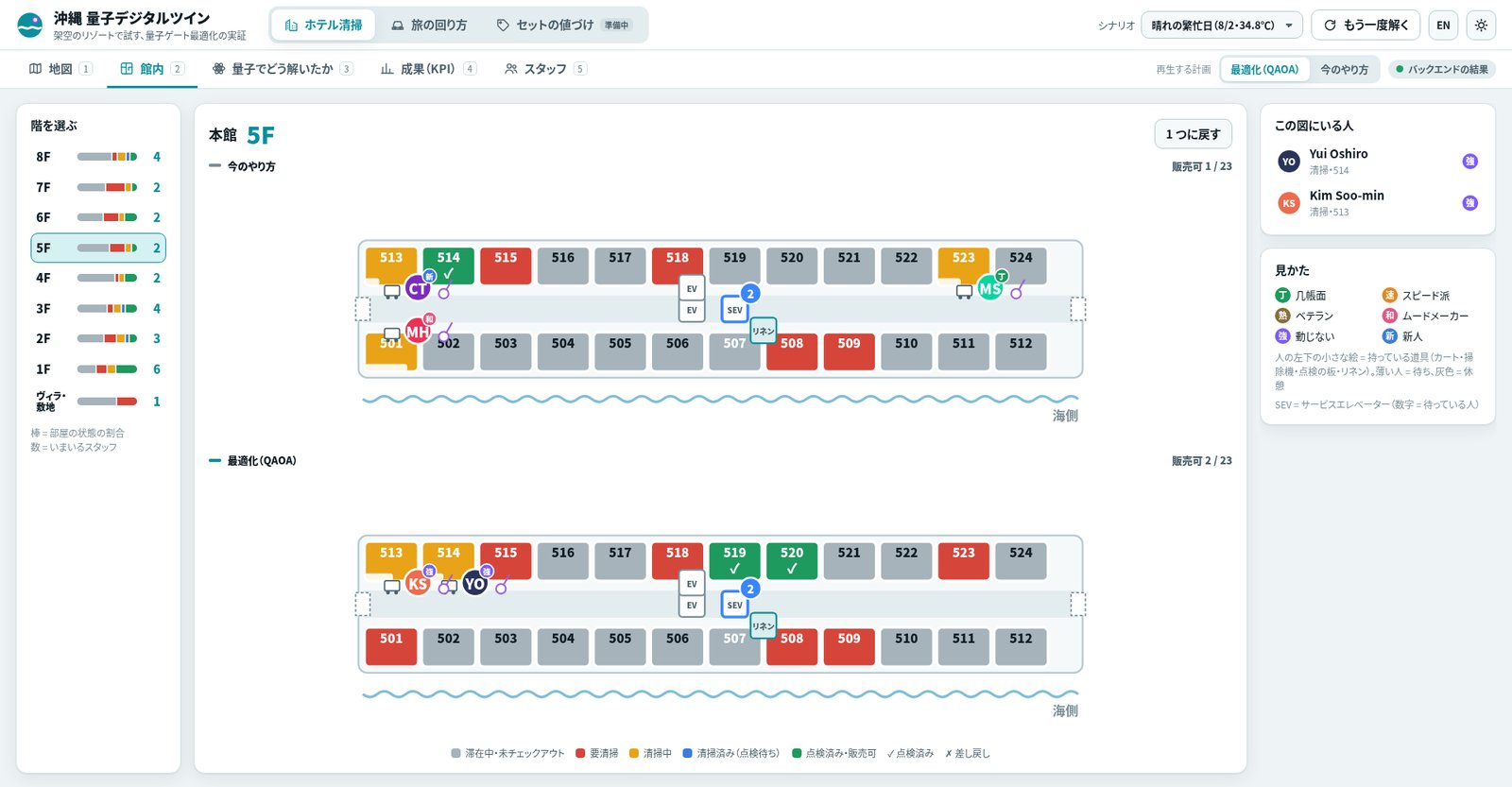

Breaking down large problems into small problems of less than 20 qubits
One day’s cleaning involves assigning "approximately 200 rooms to 22 people, in what order, and when to take lunch breaks." Since this is too large to handle directly, it was divided into smaller problems (3–20 qubits) by section and time slot, each solved using the QAOA (Quantum Approximate Optimization Algorithm). The QAOA used for planning was executed on a simulator that accurately calculates quantum circuit behavior. For comparison, the same small problems were also solved using classical exhaustive search (exact solutions).


The resulting plan was run for one day within the digital twin and evaluated as an average across five different random seed variations.
Results: 21% reduction on sunny days, 30% on days with absenteeism
The evaluation metric was "operational burden." This is the sum of delays in arrivals, overtime, uncleaned rooms, waiting for elevators or tools, and walking distance during cleaning, all converted into minutes; lower values are better.
| Day | Current Method (Whiteboard) | Quantum Division Plan | Reduction | Reference: General Optimization Software (OR-Tools) |
|---|---|---|---|---|
| Busy Sunny Day | 2,525 min | 1,991 min | 21% | 2,362 min |
| Morning Absenteeism (3 people sick) | 3,504 min | 2,456 min | 30% | 2,860 min |
| Group Check-out (40 rooms at once) | 4,676 min | 3,343 min | 29% | 3,336 min |
| Typhoon Day | 7,301 min | 7,161 min | 2% | 8,068 min |
Looking at the details of the busy sunny day, changes occurred as follows (averages across five variations).
- Percentage of rooms ready upon guest arrival: 85.0% → 89.7%
- Walking distance for cleaning: 32.9 km → 28.3 km
- Waiting due to competition for vacuums/carts: 391 min → 210 min
- Waiting for the service elevator: 282 min → 203 min
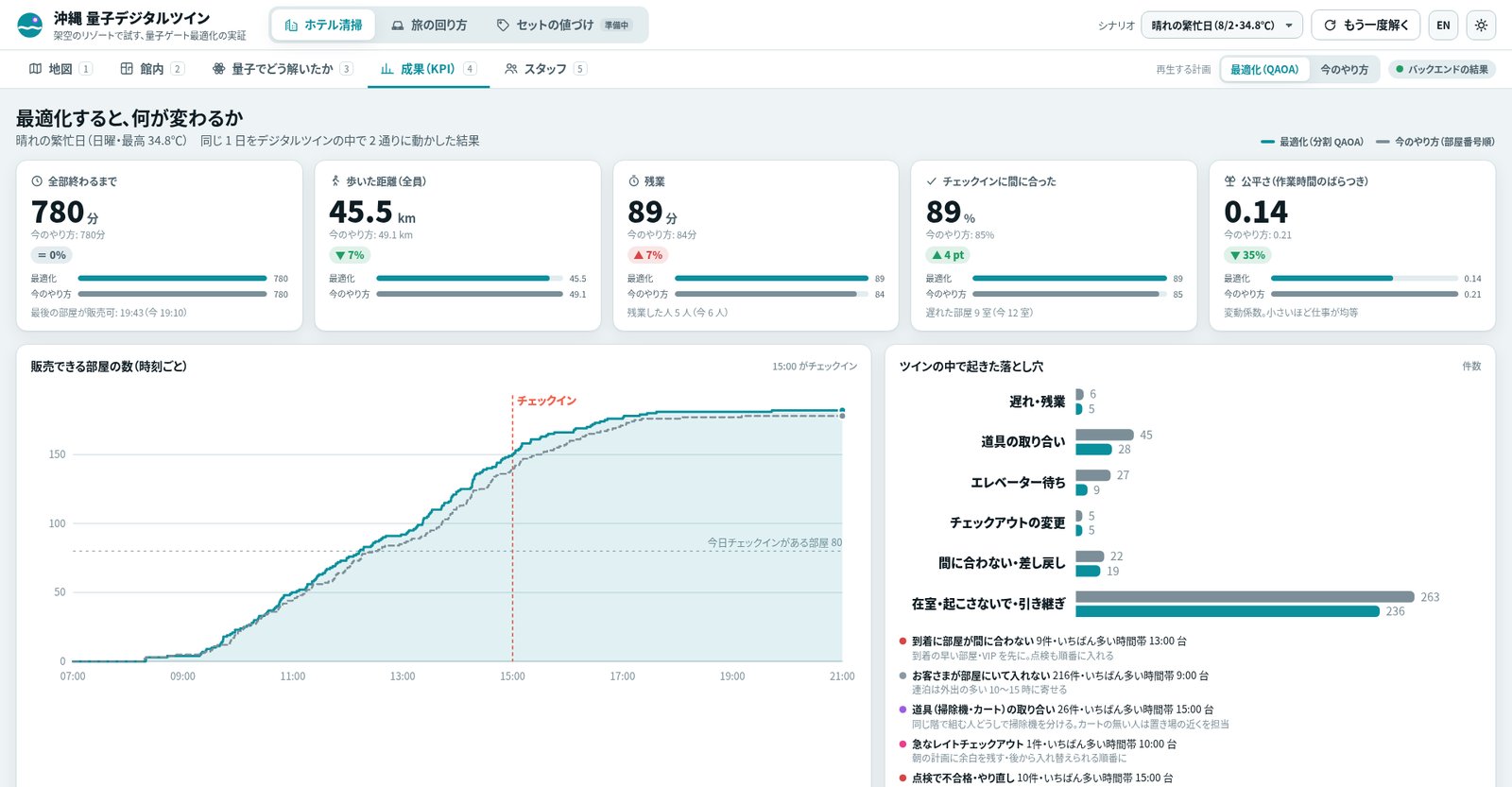
On group guest days, results were nearly identical to those of general optimization software. On typhoon days, although the burden decreased by 2%, the percentage of rooms ready upon guest arrival dropped from 82.2% to 78.2%. This was because outdoor movement was frequently halted due to rain and strong winds.
Pitfalls found in the field via Digital Twin
Running one day in the digital twin reveals bottlenecks invisible on paper schedules. For one instance of a busy sunny day (with a fixed random seed), the most common issues and countermeasures implemented in the plan are as follows:
- Guests occupying rooms preventing entry: 242 times with the current method. For multi-night stays, schedule cleaning during 10:00–15:00 when guests are more likely to be out.
- Competition for vacuums/carts: Reduced from 42 instances totaling 404 minutes of waiting to 26 instances and 224 minutes under the optimized plan. Assign vacuums among staff on the same floor, and assign areas near storage locations to those without carts.
- Service elevator waiting: Reduced from 29 instances and 112 minutes to 9 instances and 33 minutes. Concentrations occur before noon and during lunch breaks; consolidate floor movements and stagger lunch breaks.
- Inspection failures requiring redo: Avoid rushing tired staff in the afternoon. Assign VIP rooms to experienced staff.
On typhoon days, the most frequent issues were delayed responses to requests from guest rooms (33 times) and halted outdoor movement due to rain and strong winds (25 times). On days with morning absenteeism (3 people) and group guest days, "rooms not ready upon arrival" was the primary cause of significant delays.
Quantum gates, once thought capable of solving only small problems, now match classical scales
Quantum algorithms based on the quantum gate model have previously been considered incapable of solving anything beyond small problems. By devising a method to break large problems into small ones of less than 20 qubits, this study solved the entire problem of scheduling one day’s cleaning for 204 rooms and 22 people—a scale handled by classical optimization software—using QAOA.
Examining each small problem individually, the QAOA answers were of nearly identical quality to the exact solutions from classical computing (the ratio against the exact solution averaged 0.983–0.998 depending on the division method, with 1 being best). The assembled one-day plan also performed well: on sunny days, it achieved 1,991 minutes, beating the general optimization software’s 2,362 minutes; on group guest days, it matched closely at 3,343 minutes versus 3,336 minutes.
Improvements were significantly aided by the problem division strategy (grouping by floor, prioritizing urgent rooms, staggering lunch breaks) and identifying field pitfalls early via the digital twin. We aligned the quantum and classical solution approaches under the same division method and confirmed that both yielded similar answers.
Verified on actual quantum hardware
Some of the small problems were also solved on actual quantum hardware (32 qubits). The settings determined by the simulator were used directly.
Of 14 small problems ranging from 4 to 12 qubits, 13 yielded answers identical to the classical exact solutions on the actual machine, and the remaining one was nearly identical (ratio against the exact solution: 0.9999).
The one-day plan presented here was constructed based on results solved by the simulator.
Additionally, values such as work time, guest absence periods, staff compatibility, and fatigue are assumed values and do not correspond to data from existing hotels.
The same case is also introduced on blueqat’s page on quantum algorithms.