
The breakthrough in semiconductor quantum computers is control. While conventional systems have used energy to manipulate qubits, this new approach enables miniaturization, eliminates wiring, and simplifies control by using microwave sources (similar to those in microwaves) without relying on them as the direct energy source for manipulation.
Previous quantum computers required complex control achieved by meticulously combining high-end equipment. It’s somewhat like a fine French restaurant. In contrast, semiconductors aim for speed and simplicity, akin to fast food.

The mechanism involves controlling multiple qubits combined into what are called logical qubits, which is somewhat complex, but here we will explain only the operation.
The rules are extremely simple: three gears are prepared as a set. In reality, these gears correspond to electrons and represent conventional qubits, but in this context, three gears count as one qubit.
This method is called “Exchange Only” because it performs calculations using only the meshing and interaction between gears.

The rule is simple: when gears are brought close together, they interact and rotate together.
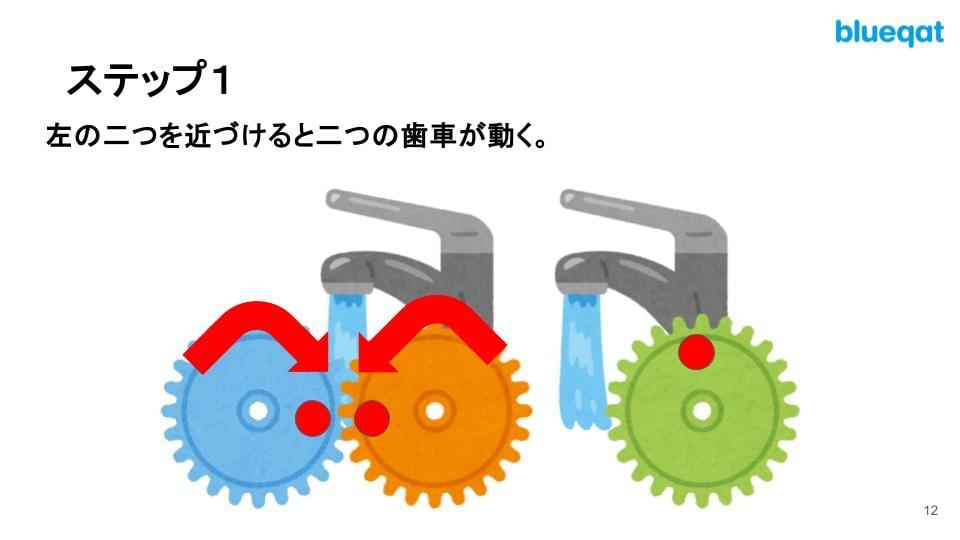
They rotate only when brought close; for example, bringing the left two gears close causes them to rotate together, while the right gear remains stationary.
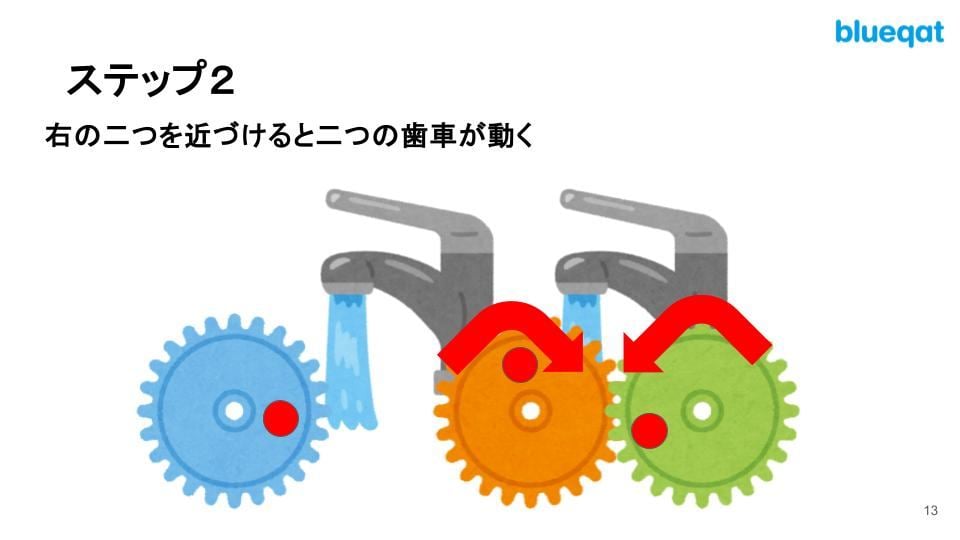
Conversely, bringing the right side close causes the middle and right gears to rotate.

When returned to the neutral position, each gear has rotated. The state of the qubit is determined based on this pattern. In practice, the positional relationship between the left two gears is mapped to the qubit’s state.
Where do we program? In conventional systems, quantum circuits are written and quantum gates are converted into pulses on the hardware side. This time, it’s slightly different.
Since there is only one type of operation—rotation—the duration of that rotation is controlled via time. Technically, this rotation corresponds to an operation known as swap time evolution.
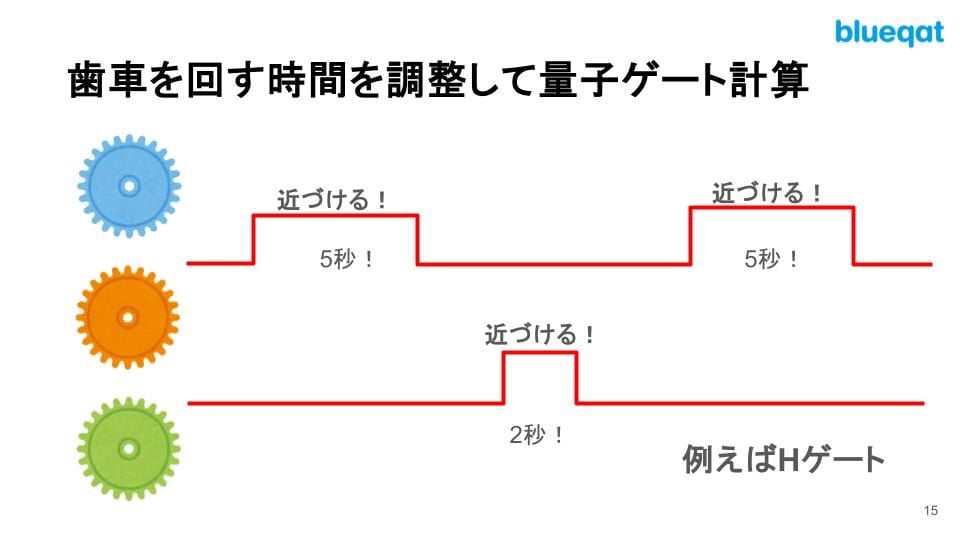
To create an H gate, three operations are performed in total, but by varying the duration of each operation, various gates can be realized.
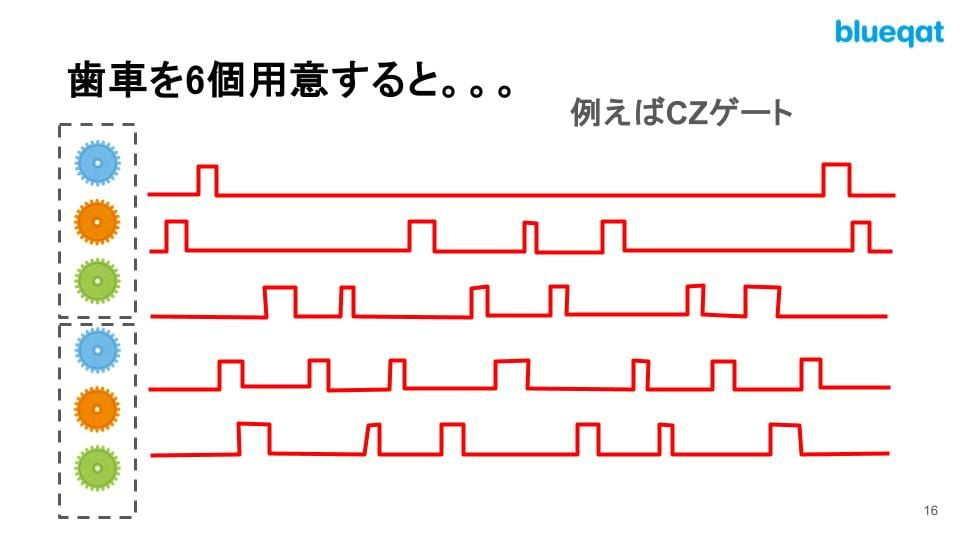
Since the number of gears can be increased arbitrarily, using six gears allows the creation of a two-qubit gate. Humans can no longer design these easily, so algorithms are used instead.
Users have already developed various EO tools.
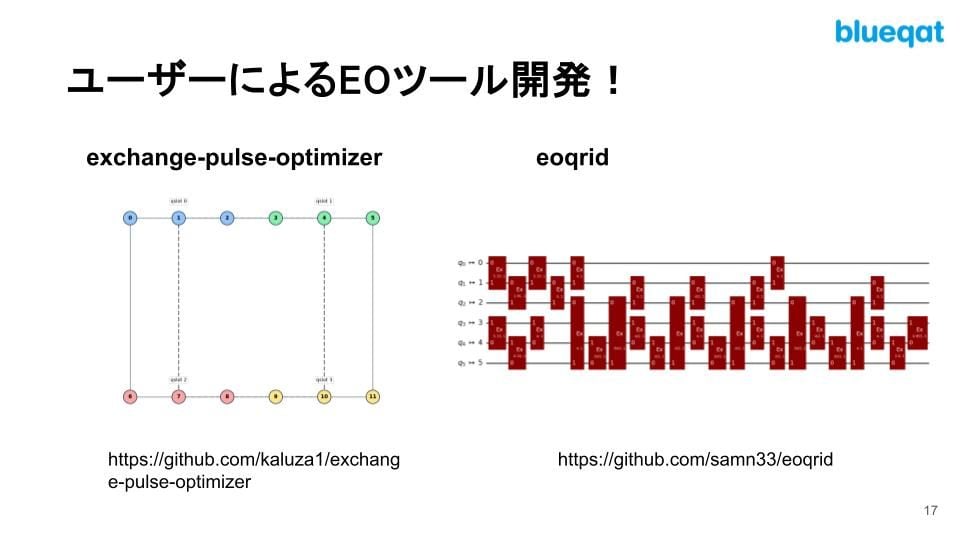
Because various quantum gates can be created for different scenarios, go ahead and design gates for your desired applications!