
"Quantum computers can only be built with a limited number of geniuses and hundreds of billions of yen in national budget."
Could this misconception be stalling innovation in Japan?
We are now launching the "Small-Start, Nationally Distributed Quantum Hardware Concept," which overturns this common sense from its roots. Our goal is not a massive facility like a supercomputer, but a landscape where "actual machines" line up in laboratories and factories across the country.
1. The "1:9" Rule: You Can Build Quantum Computers Without Understanding Quantum Physics
The core of this project lies in the thorough repurposing of semiconductor technology.
Of the components that make up a quantum computer, only 10% requires knowledge of pure quantum physics. The remaining 90% relies on high-precision semiconductor manufacturing, circuit design, and implementation technologies—areas where Japan excels.
- Reskilling Semiconductor Engineers: We will build a system where existing semiconductor engineers can participate in quantum hardware development using their current skills.
- Step-by-Step Evolution: Instead of aiming directly for quantum dots, we start by controlling "4K-FPGA/ASIC" that operate in ultra-low temperature environments. Once we grasp the key aspects of hardware, we will shift to the main target: quantum dots.
2. Overwhelming Cost Reduction via "4K GM Cryocoolers"
Until now, the barrier to entry for quantum hardware has been the rare and expensive "dilution refrigerators (in mK range)" costing hundreds of millions of yen.
We will base our approach on more common and affordable 4K (Kelvin) GM cryocoolers.
- Disrupting Costs: We will prepare an environment where development can start for just a few million yen.
- Simplifying Technology: We intentionally avoid using the typically required 3He-JT (Joule-Thomson) circuits, configuring everything with only 4K GM units. While keeping future integration of sorption modules in mind, we will first deploy "operational, cooling, and controllable" actual machines nationwide.
https://eetimes.itmedia.co.jp/ee/articles/2601/16/news022.html
This article describes how they were creating 0.3K using two types of cryocoolers: the 4KGM and the 3HeJT. Currently, by installing adsorption modules on the left-side 4KGM, they aim to achieve one rack by the end of 2026. Therefore, building your own machine or low-cost quantum computer can also begin by acquiring 4KGM units.
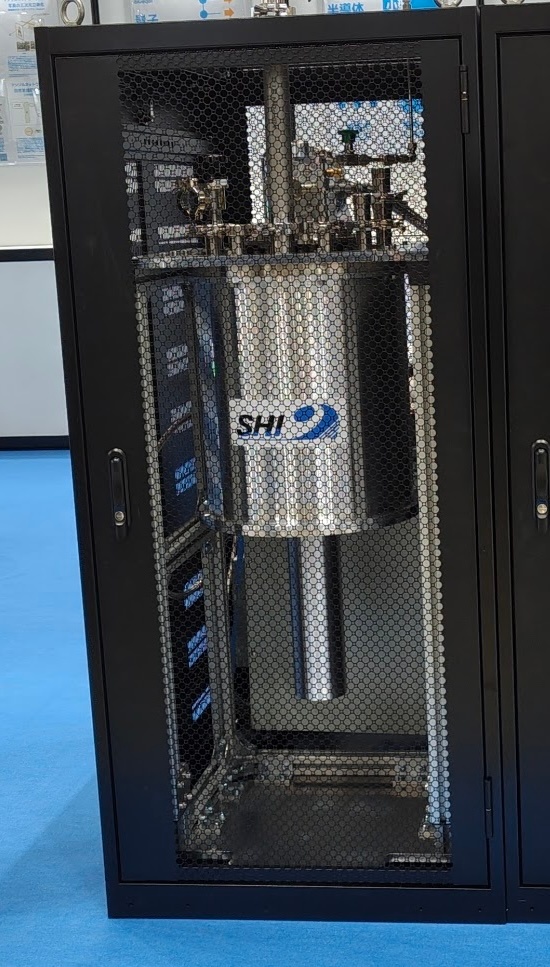
SHI in the photo stands for Sumitomo Heavy Industries. They reportedly have prepared even easier-to-understand stickers for the latest version.
3. Running "Models" and "Actual Machines" Side-by-Side Creates Next-Generation Talent
While learning theory through simulators (models), you strike the "real semiconductor quantum chip" right in front of you. This hands-on experience is what cultivates true quantum natives.
- Quantum as a Local Industry: Semiconductor-related companies across Japan will participate in the quantum hardware business and middleware development.
- Liberating DIY Enthusiasts: We transform quantum computers from expensive black boxes into objects that engineers can "build and modify themselves."
Here is an image of a model of a quantum motherboard. There is a hole in the lower front part where an adsorption-type low-temperature module is mounted; without this, you can build the basics of a quantum computer using a 4KGM. Using this quantum motherboard, you learn the control systems, and first consider FPGA/ASIC or microcontrollers using existing CMOS technology.
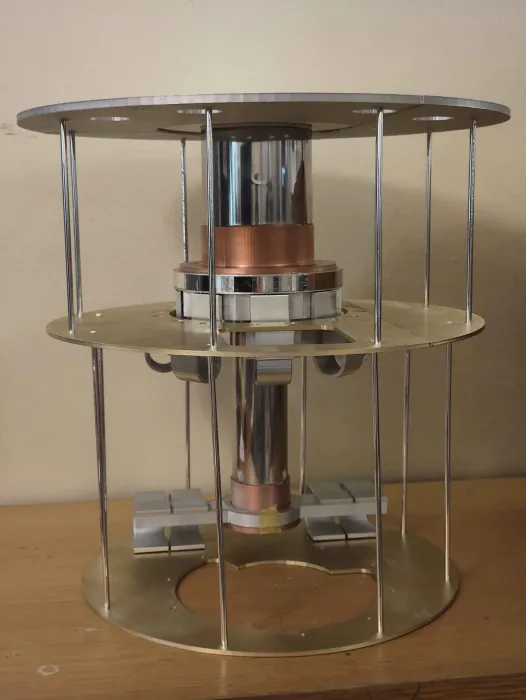
After gaining familiarity, you then mount chips called quantum dots, though the performance of the chip may vary slightly depending on the control method you wish to implement.
4. The Truth About "Market Cap" Revealed Through Market-In
There is no need to cling strictly to the narrow exit of the quantum business (product-out).
If actual machines are deployed nationwide and anyone can interact with the hardware, market-in quantum applications, reverse-engineered from "on-site pain points," will inevitably emerge.
At that point, quantum computers will evolve from mere research subjects into a "massive platform" that redefines Japanese manufacturing, ultimately achieving true market capitalization.
Together, let us witness the dawn of quantum hardware.
We will end the era of merely gazing at expensive research equipment.
Why don't we build the future of quantum computing along the continuum of such "manufacturing"—by designing chips with our own hands and sending signals in the world of 4K?