
The Journey Began with the Kansai Expo, Then Evolved into Nationwide Delivery
Semiconductor quantum computers. To help more people understand their complex and precise world, I have continued to create models. This project initially started with the goal of exhibiting at the Kansai Expo, but driven by the desire that “those who cannot make the trip to the venue should also feel the stirrings of this technology,” it has evolved into an initiative to deliver these models across the country.
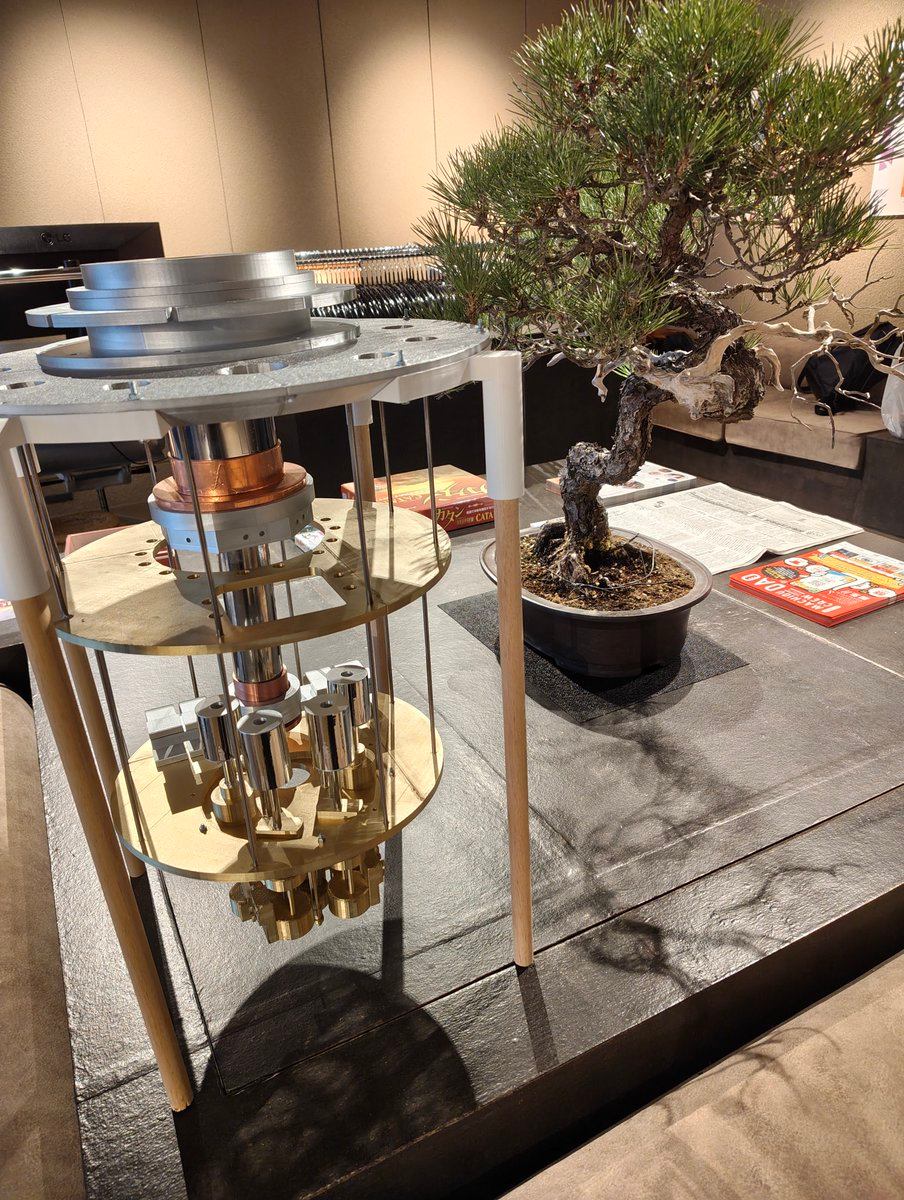
By early 2026, the number of units produced reached 15.
Initially, we started with 3D printing just to “get a shape,” but as we increased production volume, the three elements of production speed, cost, and quality changed dramatically.
1. “Optimization” of 3D Printing: Time is Asset, Design is Wisdom
3D printing is not magic where “you press a button and it’s done.” It takes 1.5 hours for one part, and up to 9 hours for longer ones. Considering the risk of failure, frequent progress management is indispensable.
I used to insist on single-piece molding, but now I deliberately print in “sections.” This is because printing complex shapes as-is requires a large amount of support material, wasting both time and resources.
- Separation and Joining: By dividing the drawings at optimal points, we achieved output in the shortest time and at minimum cost.
- Pursuit of Strength: We repeated “evolution” in 3D data, hollowing out invisible parts to reduce weight while increasing structural strength.
- Equipment Upgrade: To increase production speed, we upgraded from the Bambu A1 mini to the larger A1 model. Being able to print larger parts reduced the effort required for adhesion and drastically improved overall rigidity.
2. The Constraint of “Delivery” Determines the Design
No matter how wonderful a model is, it is meaningless if it doesn’t arrive. Here, we faced the “Wall of Size 160.”
To fit within the maximum size easily shippable via convenience stores (under 160cm), we had to rethink the design of the model itself.
- Evolution of the Frame: Initially, we used Misumi aluminum frames, but weight and cost were issues. We temporarily switched to 3D-printed feet, but they lacked strength. Ultimately, we arrived at solid wood round bars. The balance between lightness and strength was optimal for our current delivery style.
- Shift to Desktop Size: We changed the concept from large floor-standing models to “desktop size” models that can be observed closely on a desk. This allowed us to achieve both reliable delivery and ease of display.
3. Evolution of Texture: Pursuing Realism through “Suitability”
Visual persuasiveness is directly linked to the depth of understanding. Initially, we simply painted with Daiso color spray, but gradually, our obsession with “material feel” accelerated.
- From Paint to Metal: We enhanced the texture with Asahi Paint’s Metal Color and introduced stainless steel plates and silver tape to get closer to “reality.”
- Struggle with Materials: However, using stainless steel for everything is not the solution. If you attach thin plates to cylindrical parts with low curvature, they spring back like a coil and peel off. Paint, tape, and real metal plates—each has its own characteristics. The ingenuity of identifying these traits and using them appropriately according to the situation supports today’s quality.
4. The Importance of Structure: Suspended Structures and Returning Technologies
The main body of a quantum computer, especially the stage section, has a special form called a “suspended structure.” Even for a model, supporting this structure was the biggest challenge.
We initially used painted wood, but sought higher quality by replacing it with 3D-printed parts. However, plastic was insufficient to support the heavy stage. Ultimately, by adopting high-rigidity stainless steel rods as pillars, we achieved both structural stability and mechanical beauty.
Interestingly, after moving away from wood processing due to the “difficulty of painting,” we are now returning to it. With accumulated experience, I believe we can now leverage wood’s “fast processing speed” and “low cost” while finishing with high quality. We continue such challenges, which resemble a “spiral of technology.”
What the Models Teach Us
While building real semiconductor quantum computers, mass-producing models has provided surprisingly many lessons.
“How can we make things without breaking, beautifully, cheaply, and quickly?”
This question is exactly the same as the engineering spirit in cutting-edge computer development.
Efforts to improve precision are far from exhausted. I plan to continue deploying this “ever-evolving model” throughout the country.