
2025 is also coming to an end soon.
At SEMICON Japan 2025 in December this year, when you stood in front of the blueqat semiconductor quantum computer we displayed, what were you thinking?
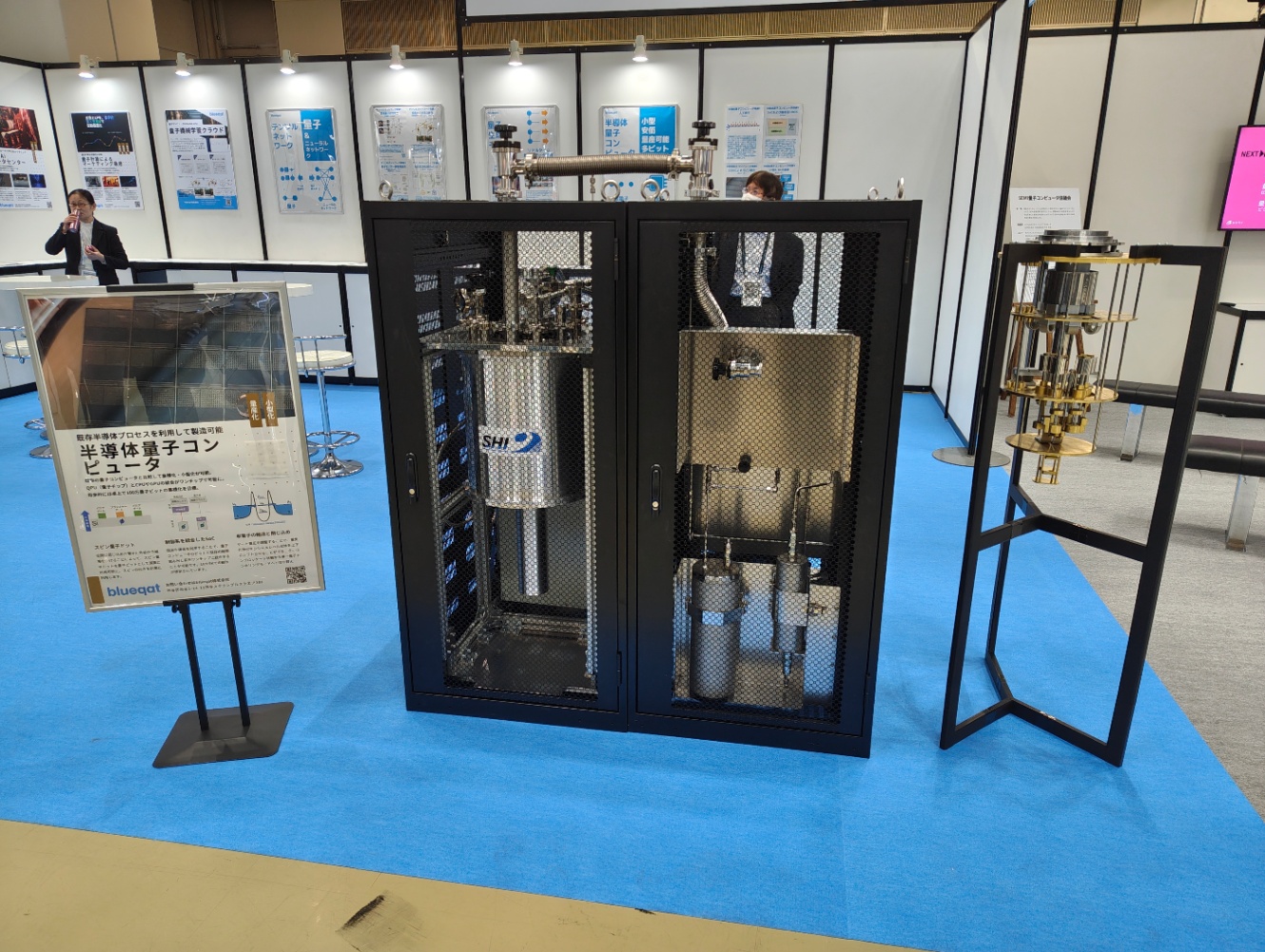
In the past, quantum computers were symbolized by their large, flashy gold structures that looked like chandeliers hanging from the ceiling. However, what was stationed at our booth was the exact opposite. It was a very quiet and compact enclosure where all systems fit into just two standard server racks.
In 2026, quantum computers will stop being "artifacts of the laboratory" and transform into the "mainstay of data centers." That compact machine we presented in 2025 is the signal for that opening act.
1. The reason we chose "mass production capability" over "flashiness"
Why were previous quantum computers so large? It was because they forcibly connected massive control devices at room temperature to quantum chips at ultra-low temperatures with thousands of wires.
Our developed machine fits into two server racks not to make it look good. This form was reached as a result of pursuing "mass production" and "scalability" to the fullest.
The flashy chandelier structure may be beautiful for research purposes, but it is unsuitable for lining up hundreds of units in a data center. Our machine can be "lined up next to data center racks starting today." This sense of reality is the key point that will determine the competition from 2026 onwards.
2. The true disruptive power of "semiconductor quantum" advancing behind the scenes
In 2025, we showed the machine as a preview, but beneath the surface, further integration aimed at 2026 is progressing.
While conventional methods construct one bit using "millimeters," our silicon spin method operates in the world of "nanometers." In other words, it means we can increase the number of qubits while keeping the same footprint as the system currently occupying two server racks in the future.
This "miniaturization x high integration" is the essence of the semiconductor method, and I am convinced that it is the only way to ensure versatility.
3. Redefining the roadmap: The shortest path to FTQC
Here, let us organize again the technical path we are taking.
Even in semiconductor quantum computing, the ultimate goal is FTQC (Fault-Tolerant Universal Quantum Computing). However, the approach to reaching there is very rational, leveraging the unique "fine-scale integration" of semiconductors as a weapon.
Strategy for placement and integration
Quantum bit placements are one-dimensional or two-dimensional. This varies depending on each company's technical advantages, but what is common is prioritizing "increasing the number of bits." With semiconductor processes that excel at miniaturization, the hurdle of increasing the number of bits is overwhelmingly lower than with other methods.
One-chip control and CryoCMOS
The ideal is to integrate the control circuit as an SoC (System on Chip) with the quantum chip. Even if that is not possible, placement in a 4K (ultra-low temperature) environment is essential. Controlling right next to the quantum bits and completing error correction near the chip. This is the key to pursuing the limits of precision.
Early 2026 will still involve coexistence with room-temperature equipment, but wiring limits will be reached from 2027 to 2028. Towards that deadline, development of CryoCMOS has officially begun worldwide.
Reliable materials and processes
Regarding materials, Si28 (Silicon-28) with high isotopic purity will remain mainstream for the time being. In response to growing global demand, production capacity is fortunately expanding, and a sufficient supply system has been established for initial lots.
Regarding processes, there is no need to chase the latest few-nanometer nodes. Many startups utilize legacy processes such as 22nm and 28nm, which are mature yet highly reliable.
4. Aspirations for 2026: A year of "solidarity" that cannot be achieved by one company alone
The development of semiconductor quantum computers is never something that can be completed by a single company alone.
While development is progressing simultaneously worldwide, our semiconductor industry's quantum teams are constantly exchanging information and adjusting the construction of the supply chain and the division of roles for chips.
"For semiconductors, horizontal connections are life."
2025 was a year where we reconfirmed those bonds and gave them shape as a physical machine.
My aspiration for 2026 is just one thing.
"To change quantum computers from special devices into mere 'computing resources'."
That enclosure, which fits into a server rack, will quietly but dramatically recalculate the world in a corner of the data center. Such a future is finally beginning.
Please see with your own eyes the power of semiconductor quantum led by blueqat in 2026.