
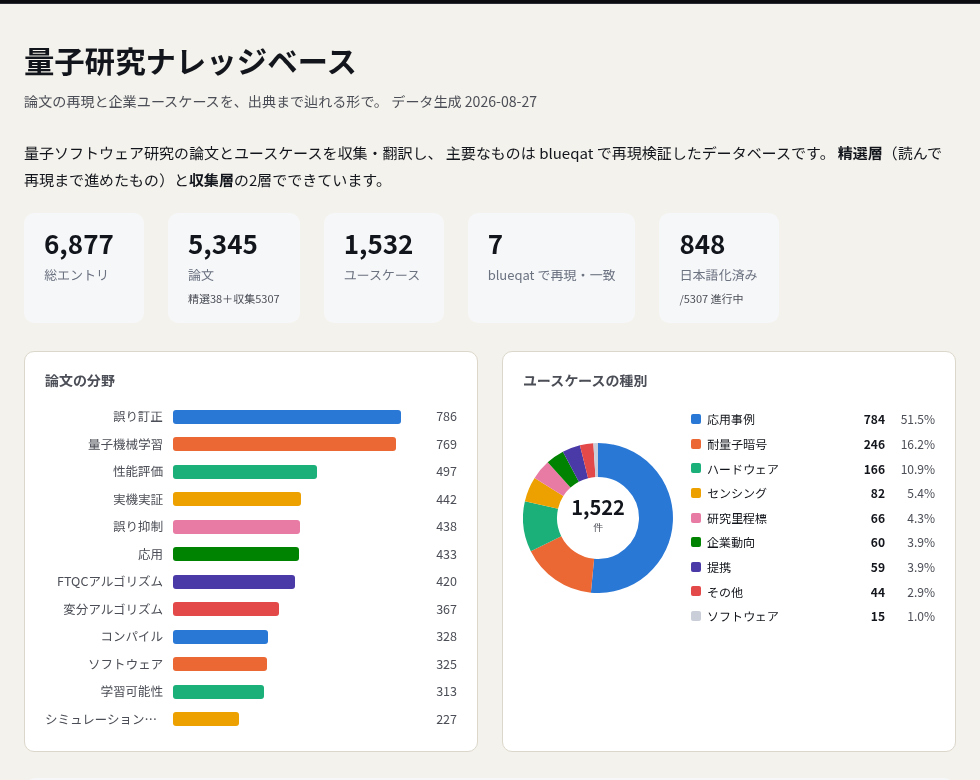
We have released a database compiling papers on quantum software research and enterprise use cases. It allows you to search through 5,345 papers and 1,532 enterprise use cases.
What You Can Read
The database is divided into two main layers.
The first layer consists of papers that were read in depth and reproduced. We have currently conducted in-depth reading of 38 papers, and for 7 of them, we actually ran them on blueqat, comparing the paper’s claims and numerical values. For example, in the well-known paper on barren plateaus in quantum machine learning, we measured how gradient magnitude decays with respect to the number of qubits, obtaining a slope of -0.6733. The paper’s reported value was -0.694, and the theoretical value was -0.6931.
The results of reproduction include not only the verdict (match, partial match), but also which claims were verified and which remain unverified. In another paper investigated using the same methodology, 3 out of 4 experiments matched, while the remaining one showed an 8-sigma discrepancy. This entry includes even the identification of the cause.
The second layer consists of collected items. This includes 5,326 papers and 1,522 enterprise use cases. These have not been subject to in-depth reading or reproduction; they are provided for search purposes. The papers were obtained directly from arXiv, and all IDs have been verified. The enterprise use cases were extracted from past articles on this site, and link to the original articles.
The collected items will be subjected to in-depth reading in due course. Items that have completed in-depth reading are marked in the same search results.
Separating Facts from Assumptions
Enterprise use cases contain not only publicly available facts, but also items where algorithms were inferred from those facts.
For instance, in HSBC’s initiative on bond trading using IBM’s real hardware, announcements such as “up to 34% improvement in prediction of fill probability compared to classical methods” and “the method is called Projected Quantum Feature Map” are listed as facts with sources. On the other hand, how that feature map is constructed has not been disclosed. We present such items as assumptions, in a separate section, with a confidence level attached.
Avoiding presenting assumptions as facts is the most important design principle of this database. We differentiate sections, colors, and headings, and always include a confidence level (high, medium, low). For collected items, where the basis for assumptions is even weaker, we add stronger warnings.
Available in Japanese
We are translating the titles and abstracts of the collected papers into Japanese. Currently, 848 papers are available to read in Japanese.
How to Use
The Knowledge Base is available to those who log in with a blueqat account and subscribe to a plan. There are two plans: ¥980 per month and ¥10,000, summarized on the Plan Information page.
With the ¥980 plan, you can read the reproduction verdicts and verification contents, publicly available facts of enterprise cases with sources, and algorithm assumptions. With the ¥10,000 plan, you additionally gain access to reading notes, the computation time used for reproduction, quantum circuit generation rules, and formulas. This tier is aimed at those who wish to replicate the experiments locally.
For papers that have not yet been reproduced, we have placed a button saying “I want this paper’s reproduction prioritized.” We will proceed with requests in order of popularity.
Looking Ahead
We continue to expand the scope of collection. As articles on this site increase, so will the enterprise use cases; we are also continuing to collect papers. Data is ingested daily.
Please note that this database was created from blueqat’s quantum software research and is developed independently from the articles on this site. The articles remain freely accessible to everyone, as always.