
Introduction – The Choice to Run on Local Machines
We are starting a new series titled "The Current State of Local LLMs" on blueqat news. In this first installment, we will organize the overall picture of what local LLMs are and why they are currently attracting attention. Starting with Part 2: Open Weights, Quantization, and VRAM, we will dive into the internals of the models (weights and memory).
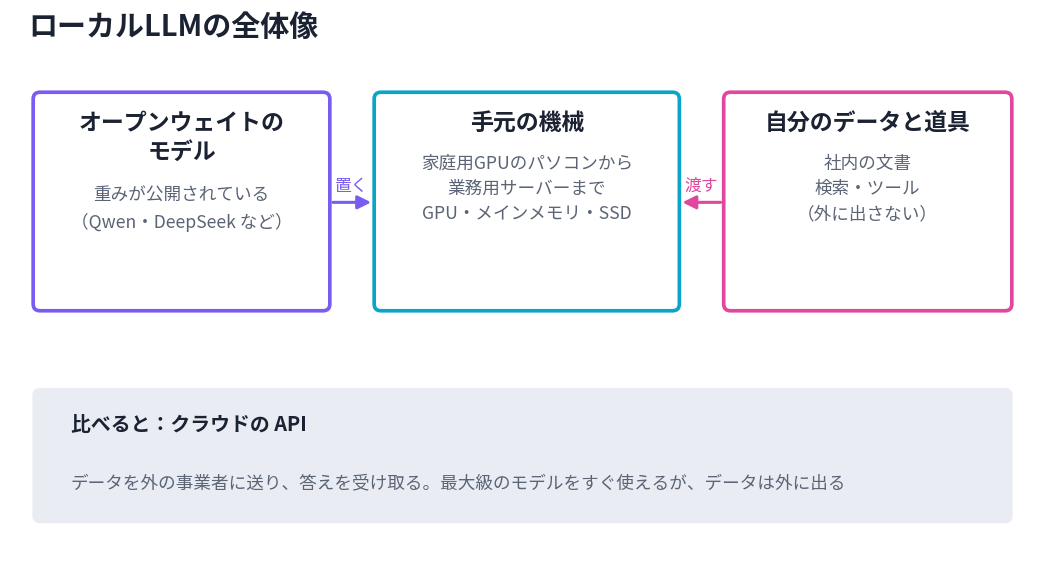
Local LLMs refer to large language models run on your own devices. Your own devices include desktop PCs on your desk or servers located within your company. Crucially, these models utilize open-weight models. Open weights indicate that the model's weights are publicly available and can be stored and run locally. The defining characteristic is that computation is completed locally, without querying external cloud services.
We also discuss these same topics in a video. You can watch the video on YouTube: "Local LLMs Take Center Stage: From Parameter Arms Races to Tool Usage".
What Are Local LLMs?
The term "Local LLM" might lead some to think of "small models." However, the models currently runnable on local devices are by no means small. Models with total parameter sizes reaching hundreds of billions are available as open-weight models. It is closer to reality to view this not in terms of size, but in terms of placement and usage.
The most common devices for running these models are personal computers equipped with consumer-grade GPUs. I feel that the number of people worldwide who want to try generative AI locally has increased significantly, causing Mac Studio and DGX Spark units to sell well and GPUs to go out of stock. The reason for the expansion of local LLMs lies in the fact that they can be run on devices accessible to individuals or small teams, not just large compute centers. Of course, when moving to the stage of running them daily for business, there is also the option to shift to professional-grade equipment from a management and quality perspective. We will touch on blueqat's example later.
The models used are those published as open weights. If you download the weights and place them on your own device, you can use them without passing through external services. Many of the models listed in the table below are published under licenses such as Apache-2.0 and MIT, which allow commercial use. License conditions vary by model, so you must verify the specific conditions for each model before using it.
In summary, the form of local LLMs is using "open-weight models" on "local devices" to "complete computations locally." When these three elements are aligned, you gain the ability to decide all aspects: where your data is stored, which models you use, and your operational configurations.
The Axis of Competition Has Shifted from "Size" to "Tool Usage"
Until recently, model development competitions were about parameter counts. The prevailing idea was that increasing numbers improved intelligence, increased knowledge, and reduced errors. I believe this competition has largely cooled down. The perspective is that the performance of the models themselves has plateaued.
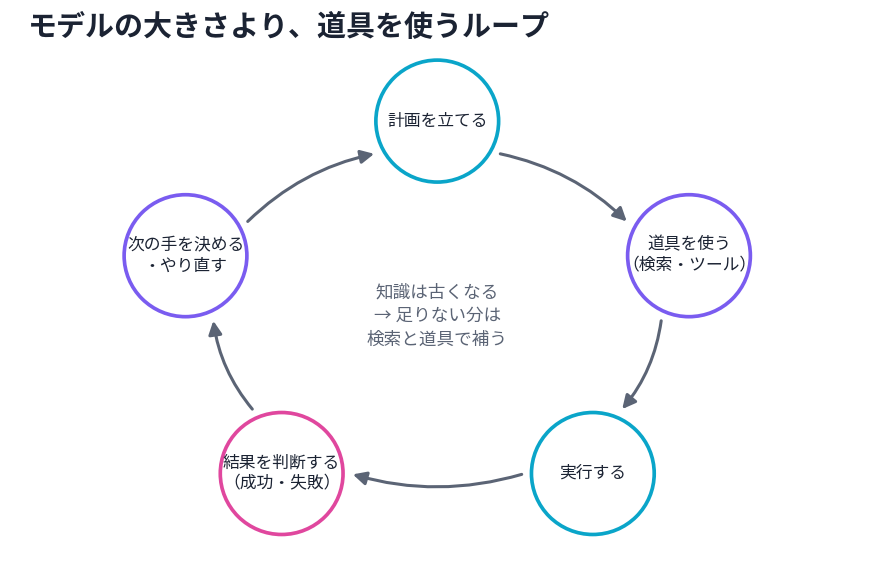
Instead, the increase in weight has been directed toward tool usage. Knowledge contained within parameter counts becomes outdated quickly. Relying solely on this knowledge leads to mistakes. Therefore, real-time information is retrieved via search. Based on search results, procedures are constructed to determine how to combine various tools to solve a specific query. The tool is executed, success or failure is judged, decisions are made for the next step, and the tool is used again. This loop, or harness, is what I consider to be the key focus.
In other words, even with limited knowledge, effective tool usage can compensate. Models with higher intelligence read more deeply and create better plans for execution. The current primary focus is on whether the loop of planning and execution can be maintained properly.
Within this trend, we cannot overlook the expansion of choices. Previously dependent on a limited number of models, various companies in China are now releasing models that run locally. These are positioned as models that may lack comprehensive knowledge but excel in tool usage, are lightweight, and run on local GPUs. blueqat also utilizes multiple models. The table below lists models used by blueqat and frequently mentioned models. However, I believe it is most reliable to verify which model suits which task by testing them locally. I also add the premise that the situation may change in six months.
Open-Weight Models That Run Locally
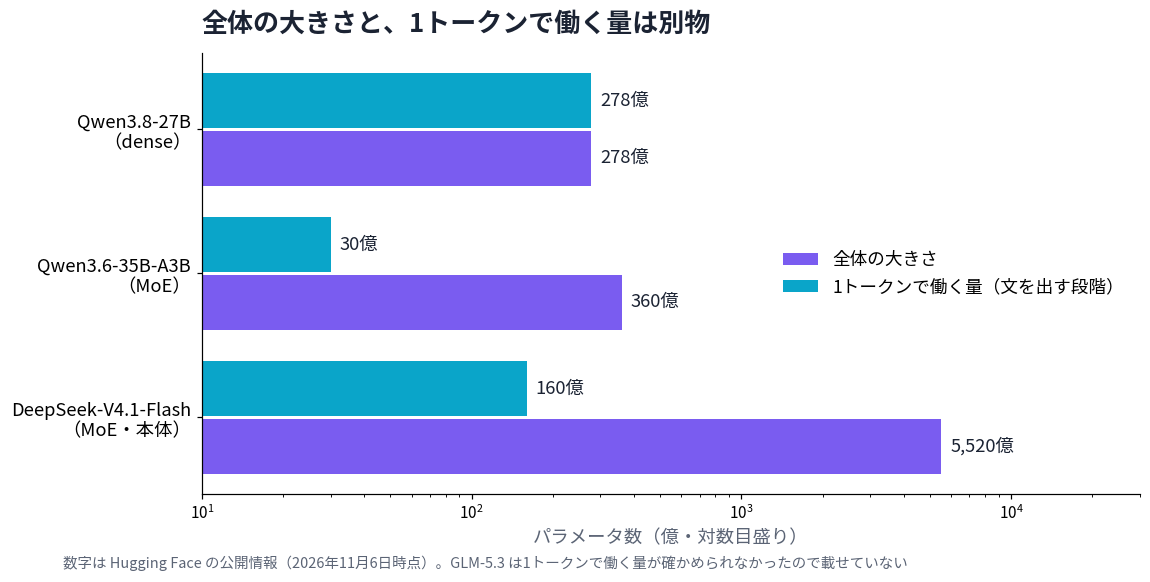
The figures below are based on information confirmed via Hugging Face. "Total size" refers to the parameter count, and "Amount working per 1 token" refers to the number of parameters actually computed during inference.
| Model | Total Size | Amount Working Per 1 Token | Format | License |
|---|---|---|---|---|
| Qwen3.8-27B | Approx. 27.8 billion | All (dense) | Dense, 64 layers, 262,144 tokens context | Apache-2.0 |
| Qwen3.6-35B-A3B | Approx. 36.0 billion | Approx. 3.0 billion | MoE (256 experts per layer, 8 selected per token) | Apache-2.0 |
| DeepSeek-V4.1-Flash | Core 552.0 billion (Total published files approx. 760.0 billion) | 8.0 billion (Input) / 16.0 billion (Output) | MoE, Max 1 million tokens context | MIT |
| GLM-5.3 | Approx. 753.0 billion in published files | ― | ― | ― |
Qwen3.8-27B is a dense model that uses all weights every time. Consequently, the amount working per token is the same as the total, approximately 27.8 billion. Qwen3.6-35B-A3B is an MoE model; as indicated by "A3B" in its name, only approximately 3.0 billion parameters work per token. Although the total is approximately 36.0 billion, the structure is such that the actually active part is light. DeepSeek-V4.1-Flash is an MoE model with a core of 552.0 billion parameters. It activates 8.0 billion parameters when reading input and 16.0 billion when generating output. It supports a context of up to 1 million tokens and has an MIT license. The total size of the published files amounts to approximately 760.0 billion parameters. For GLM-5.3, information up to approximately 753.0 billion parameters in published files has been confirmed, but other columns cannot be filled with the current material.
What can be read from this table is that total size and the amount working per token are not necessarily proportional. Even if the total is in the hundreds of billions, designing the model to select only the actively running parts creates room for it to run on local devices. This is the starting point for considering the current state of local LLMs.
Using Not Just GPUs, But Main Memory and SSDs
For several years, it was assumed that running large models required loading all weights into GPU memory. This assumption is being undermined by changes in how models are built. The key here is the Mixture of Experts (MoE) structure.
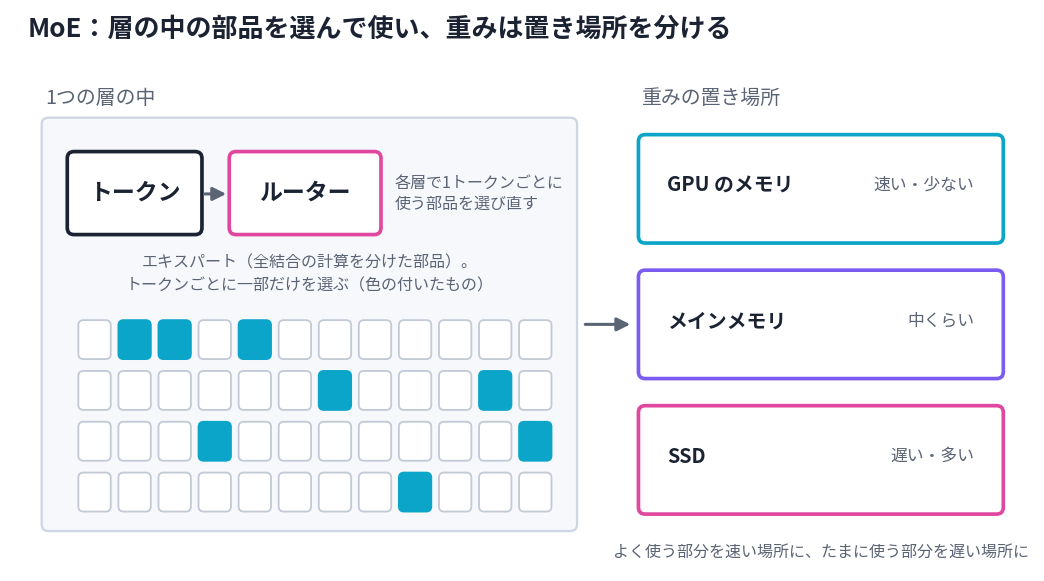
MoE is often described as "a collection of many small LLMs," but this is inaccurate. Experts are components within each layer, representing a split of fully connected calculations. Furthermore, each layer has a router that reselects which experts to use for each token generated. That is, selection is repeated for the number of layers. Even if the total parameter count of the model is large, only a tiny fraction of parts actually work when outputting one token.
Let's look at the numbers. Qwen3.6-35B-A3B is an MoE model with approximately 36.0 billion parameters. It has 256 experts per MoE layer and selects 8 per token. The amount working per token is approximately 3.0 billion parameters. DeepSeek-V4.1-Flash is an MoE model with a backbone of 552.0 billion parameters. It works with 8.0 billion parameters when reading input and 16.0 billion when generating output. It supports a context of up to 1 million tokens, and the total of published files amounts to approximately 760.0 billion parameters. While the total is huge, the amount that moves at once is orders of magnitude smaller.
By leveraging this property, weights do not need to be compressed solely into GPU memory. Weights are distributed across three storage locations: the GPU, the PC's main memory, and the SSD, and computation is managed with prioritization. Components in slower locations are used less frequently, while frequently used components are placed in faster locations. By optimizing such resource allocation on the software side, it has become possible to run models at practical speeds on local devices. As an example of software that runs inference efficiently, there is Strata (How to Read Strata Benchmarks). The current situation is that processing once requiring very expensive, large machines can now be handled through the optimization of a set of PCs.
Differentiation by Use Case
Local LLMs enable us to move away from the idea of using the most expensive hardware to handle everything. I believe we should select tools based on the difficulty of the task.
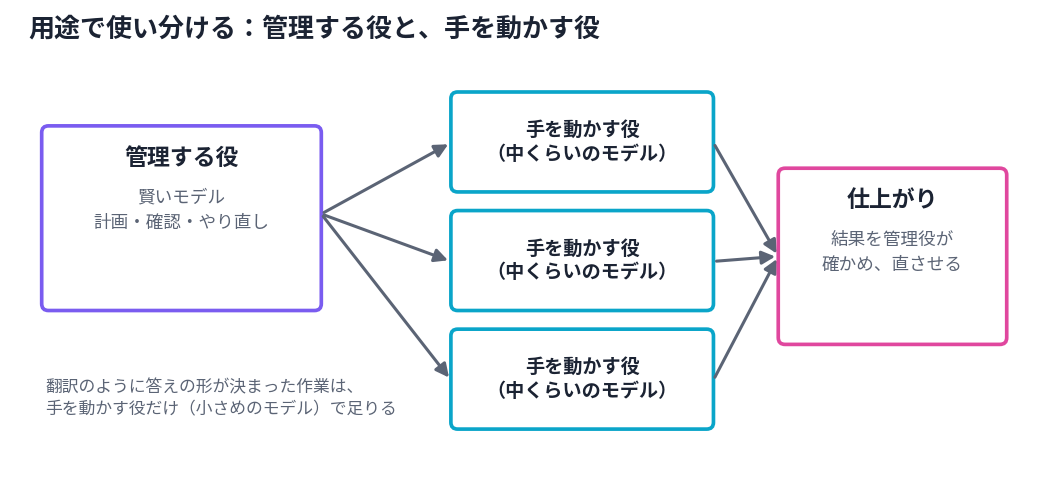
A clear example is translation. The task of translating from English to Japanese can be fully handled without deploying the most expensive GPUs. On the other hand, programming can be divided into two roles: a manager role that oversees overall design and issues instructions, and a hands-on role that actually writes the code. If we assign a model skilled in tool usage to the manager role, I believe that even medium-skill models can handle a certain level of programming. This is similar to human work: separating the judging role from the hands-on role and repeating revisions with care leads to completion. There is no need to keep a high-end GPU running from start to finish.
The concept of narrowing down fields is also important. In industries such as chemical manufacturers, automotive manufacturers, and finance, the types of required computations are limited. Rather than preparing a universal, expensive model, placing a model tuned to that specific field is more likely to yield results. When I was developing quantum computer applications at blueqat, the required computations were limited within each company's specific fields. Additionally, by devising tool designs to reduce execution time, GPU utilization rates can be lowered, saving on electricity costs and resources when used by multiple people. Maximizing effects and minimizing costs. I consider this design philosophy to be the current practical interest.
Advantages and Cautions of Local Deployment
The biggest advantage of running locally is that there is no need to send data externally. The range in which companies can process their data without entrusting it to large clouds has expanded. Another advantage is the peace of mind that comes from local completion. Even if cloud services become unavailable, your work will not stop, preventing inconvenience. It is not necessary to be universal; as long as it can be structured to fit your business, that is sufficient, which is my assessment.
On the other hand, there are points to be cautious about. Owning hardware yourself means you are responsible for its management. We at blueqat previously used dozens of consumer GPUs (RTX 3090), but we disposed of them due to management burden and quality control, and now use professional-grade equipment (details in our previous post From DIY GPU Machines to Professional Servers). Quality management is an issue that inevitably accompanies performance discussions, independent of raw performance metrics.
Furthermore, as a global increase in people wanting to test models locally has occurred, hardware shortages have arisen. Not only GPUs, but also memory and SSDs have become difficult to obtain, creating a reality where even if you want to acquire them, you cannot. If considering introduction, you must take this supply and demand into account.
Six Months and One Year From Now
I cannot see clearly how far this trend will continue. Hardly anyone predicted the current situation a year ago, indicating just how fast changes are occurring. At least at this moment, local LLMs have the advantages of having a wide range of applications, controllable costs, and local completion. While carefully observing when the trend will settle, I believe it is important to thoroughly master this area now.
Topics Covered in This Series
In Part 1, we looked at the overall picture of local LLMs and why they are attracting attention in this form now. In subsequent parts, we will sequentially address specific issues necessary to actually run, select, and master them.
- Weights and Memory: What models are made of and where they reside
- Quantization: What you gain in exchange for precision
- Attention Mechanism and Long Context: Mechanisms and limits for handling long inputs
- Inference Engines: Differences in the software that runs them
- Choosing GPUs and Memory: Criteria for building machines
- Usage Differentiation with Clouds: How far to keep locally and where to outsource
- Actual Measurements: Viewing results of actual runs in numbers
Next Part: Part 2: Open Weights, Quantization, and VRAM