
blueqat accepts applications for joint proof-of-concept experiments using blueqat’s systems, starting from the challenges faced by enterprises in their actual operations. Beginning with specific issues such as “we want to improve this part of this process” in areas like shift scheduling, delivery, inventory, pricing, design, and research, we verify solutions side-by-side on a digital twin (a virtual representation of real facilities and human movements) that replicates the actual workplace, comparing both quantum and classical approaches.
What We Use
For the proof of concept, we combine the following systems developed and operated by blueqat:
- blueqat poqet: A mechanism that allows users to proceed from assembling to executing quantum algorithms simply by describing their goals in words
- Quantum circuit simulator: Accurately calculates the behavior of quantum circuits on computers to extract candidate answers
- In-house inference engine (Tachyon-v100): An inference engine developed by blueqat to run language models
- Digital twin: Replicates detailed workplace conditions within a computer, including people, tools, buildings, weather, and unexpected events
Which components are used depends on the specific challenge; not all components are necessarily employed.

Example: Cleaning and Shift Scheduling at an Okinawa Resort
As an initial example, we conducted a proof of concept for room cleaning and staff shift scheduling at a fictional resort (204 rooms) located along the coast in Onna Village, Okinawa (for details, see “Optimizing Okinawa Resort Cleaning and Shift Scheduling with Quantum Algorithms: Proof of Concept Using a Digital Twin of 204 Rooms”).
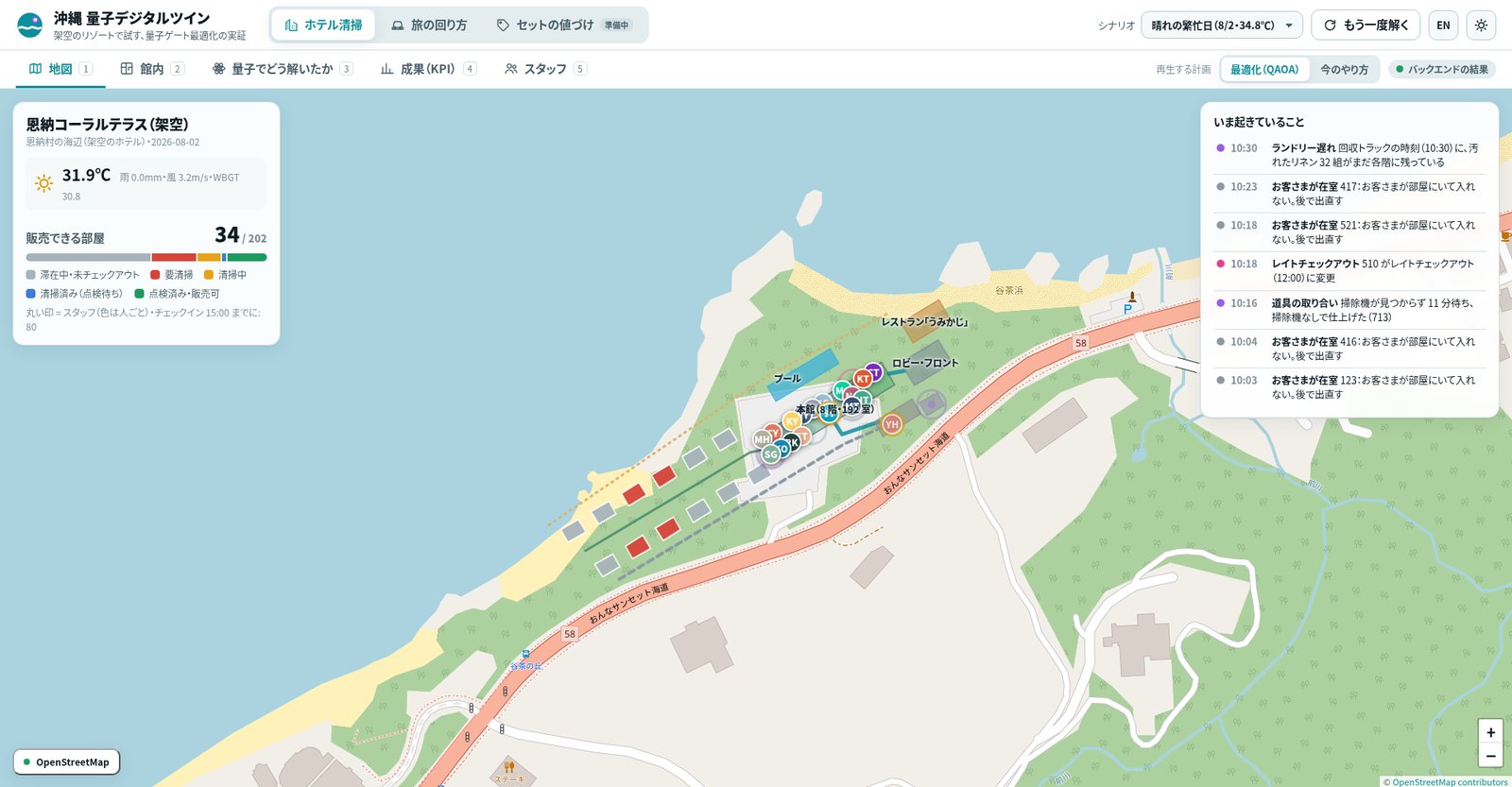
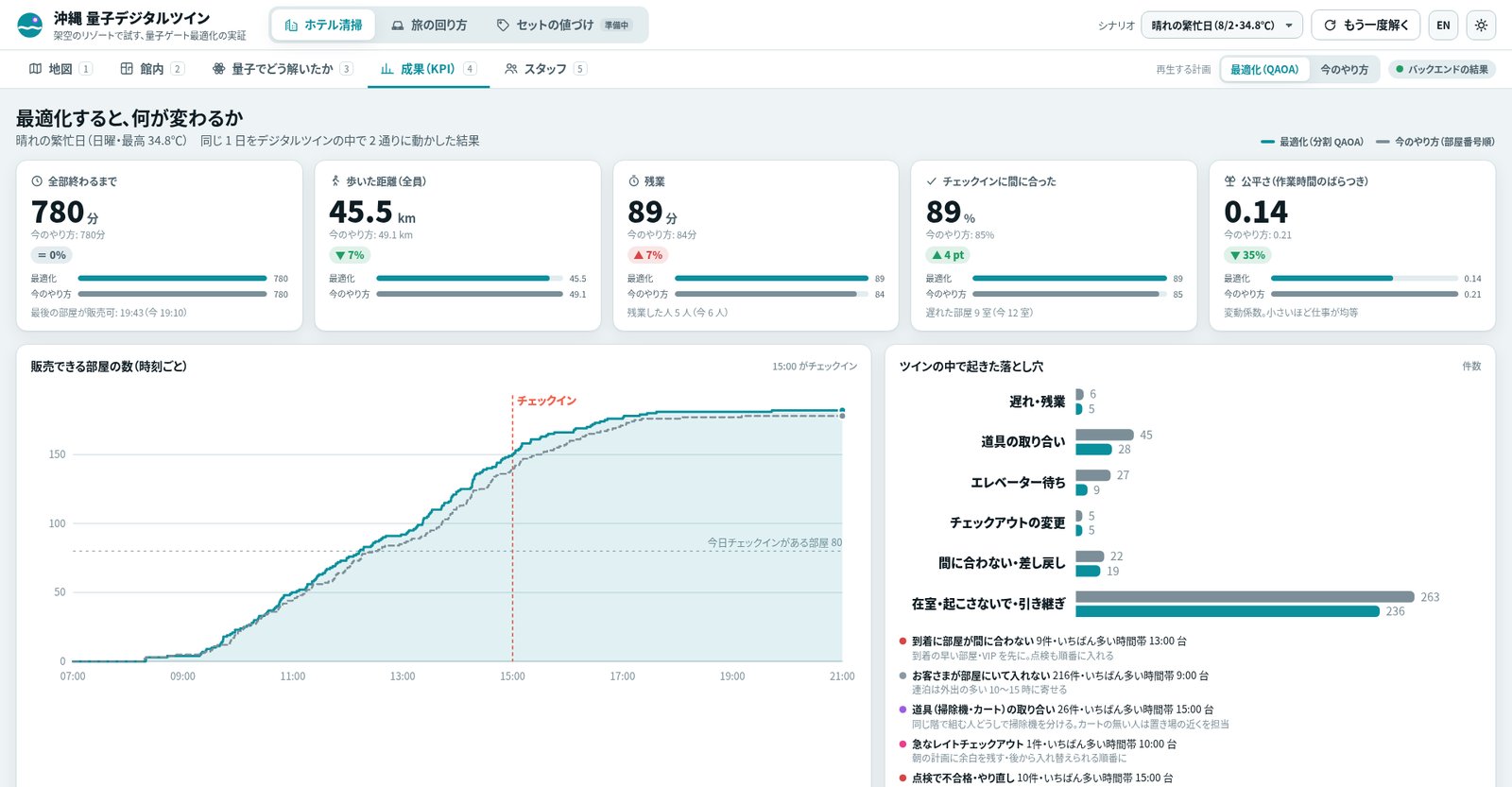
By running a one-day simulation in a digital twin that incorporated factors such as individual staff speed and fatigue, the number of vacuums and carts, service elevators, heat, rain, and wind, we found that operational burden (including delays and overtime converted into time units) decreased by 21% compared to current methods on busy sunny days.
By carefully structuring how problems were divided, we were able to solve problems of a scale similar to those handled by classical computing using the quantum gate algorithm (QAOA), which has been said to only handle small problems, and obtained answers comparable to those from classical computing. We also solved some smaller problems on actual quantum hardware; for problems up to 12 qubits, we obtained exact or nearly identical answers. In the proof of concept, we report results by presenting quantum and classical outcomes side-by-side.
Example of Progression
Although it varies depending on the challenge, the general progression follows these steps:
- Challenge Interview: We inquire about which business processes need improvement, the current methods, and pain points
- Digital Twin Replication: We replicate people, materials, time, and constraints with the level of detail necessary for verification, incorporating real available data such as public weather and map data
- Comparison of Problem Decomposition and Solution Methods: We divide large problems into smaller ones manageable by quantum algorithms. We solve the same problems using both quantum methods and classical methods (general optimization software and exact calculations) side-by-side
- Verification in the Twin: We run the resulting plans within the digital twin, repeating trials with varying random numbers to compare against current methods
- Reporting and Visualization: We summarize numerical comparisons and evaluations, including unsuccessful aspects, and provide access to a dashboard displaying the results
We always compare quantum and classical approaches side-by-side to clearly distinguish whether improvements resulted from “using quantum technology” or from “better problem structuring.”
Differences from Generative AI Trials
blueqat is separately recruiting companies to participate in a trial of quantum computing using generative AI. This initiative involves participating companies using generative AI to advance quantum computing based on their own business challenges, verifying its practical utility with support from blueqat personnel.
This proof of concept is individually tailored by blueqat, encompassing digital twin creation and solution comparison based on enterprise challenges. If you are unsure which approach suits your needs, please consult us first.
Consultation Contact
Costs, duration, and participation conditions will be discussed individually after reviewing the nature of your challenge. Interested companies should contact us via blueqat’s inquiry page.
Case studies using quantum algorithms are also introduced on blueqat’s quantum algorithms page.