
blueqat conducted a demonstration to organize a one-day sightseeing route around Okinawa by car using a quantum algorithm. By creating a digital twin of the roads and tourist spots on Okinawa Island—reproducing real traffic volume, travel speeds, weather conditions, and tourism statistics—they verified the generated plans by running them 300 times each day. For a family with small children spending one summer day traveling, the "enjoyment score" reached 2.3 times that of a typical itinerary. The plans utilizing the quantum algorithm produced results equivalent to those obtained via classical computing methods.
Four Traveler Groups and Real-World Data
Four traveler groups were prepared (all fictional):
- A family with a 1-year-old and a 4-year-old child. Departing from their hotel on a Sunday in midsummer, returning on an evening flight.
- A couple touring in an electric vehicle (EV). On a Saturday in November, aiming for sunset views, the sea, and photography. Departing with a battery level of 55%.
- An elderly couple who enjoy history and culture, walking no more than 4 km per day. Returning on an evening flight.
- Friends from Taiwan. Visiting on a rainy Thursday, focusing on shopping and street food.
Roads and tourist destinations were constructed from publicly available real-world data.
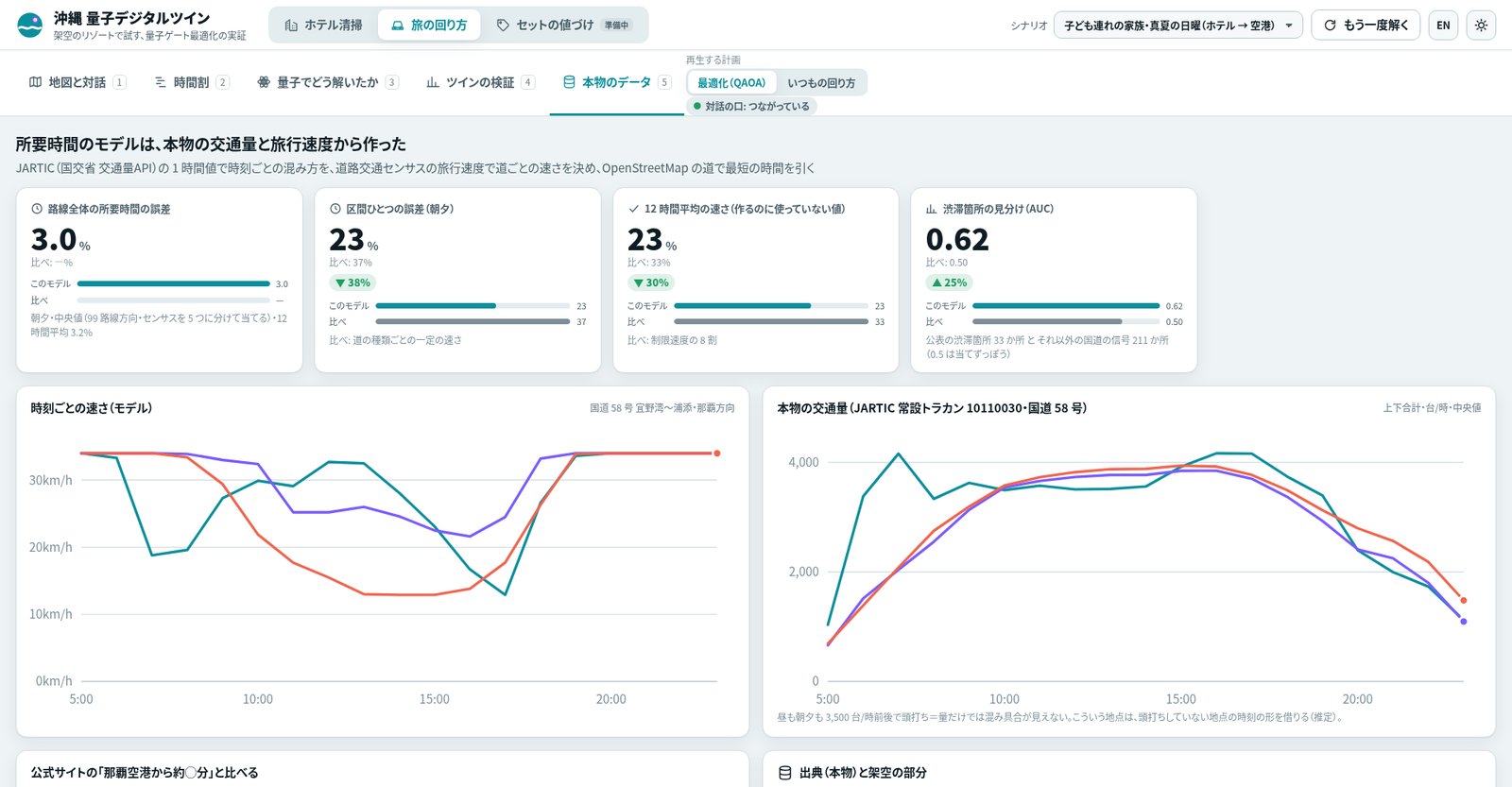
- Hourly traffic volume: JARTIC Open Traffic Data (Ministry of Land, Infrastructure, Transport and Tourism Traffic Volume API)
- Travel speed by section: Road Traffic Census (Reiwa 3 fiscal year)
- Weather: Hourly values for Nago and Naha from the Japan Meteorological Agency
- Tourist density: Okinawa Prefecture inbound tourism statistics; cruise ship port calls: Naha Port Management Association
- Locations of roads, tourist spots, and EV chargers: OpenStreetMap
- Business hours and parking lots: Official websites of respective tourist spots
The profiles of travelers, some dining options, and congestion patterns at tourist spots are assumptions. The road travel time model was validated against the Road Traffic Census, showing an error margin of 3.0% for overall route times.
Communicating Preferences to Adjust Plans
The interface allows users to replay a day’s itinerary on a map. By entering preferences such as “It looks like it will rain, so focus on indoor activities” in the dialogue window on the right, the system interprets these conditions and reorganizes the plan accordingly.
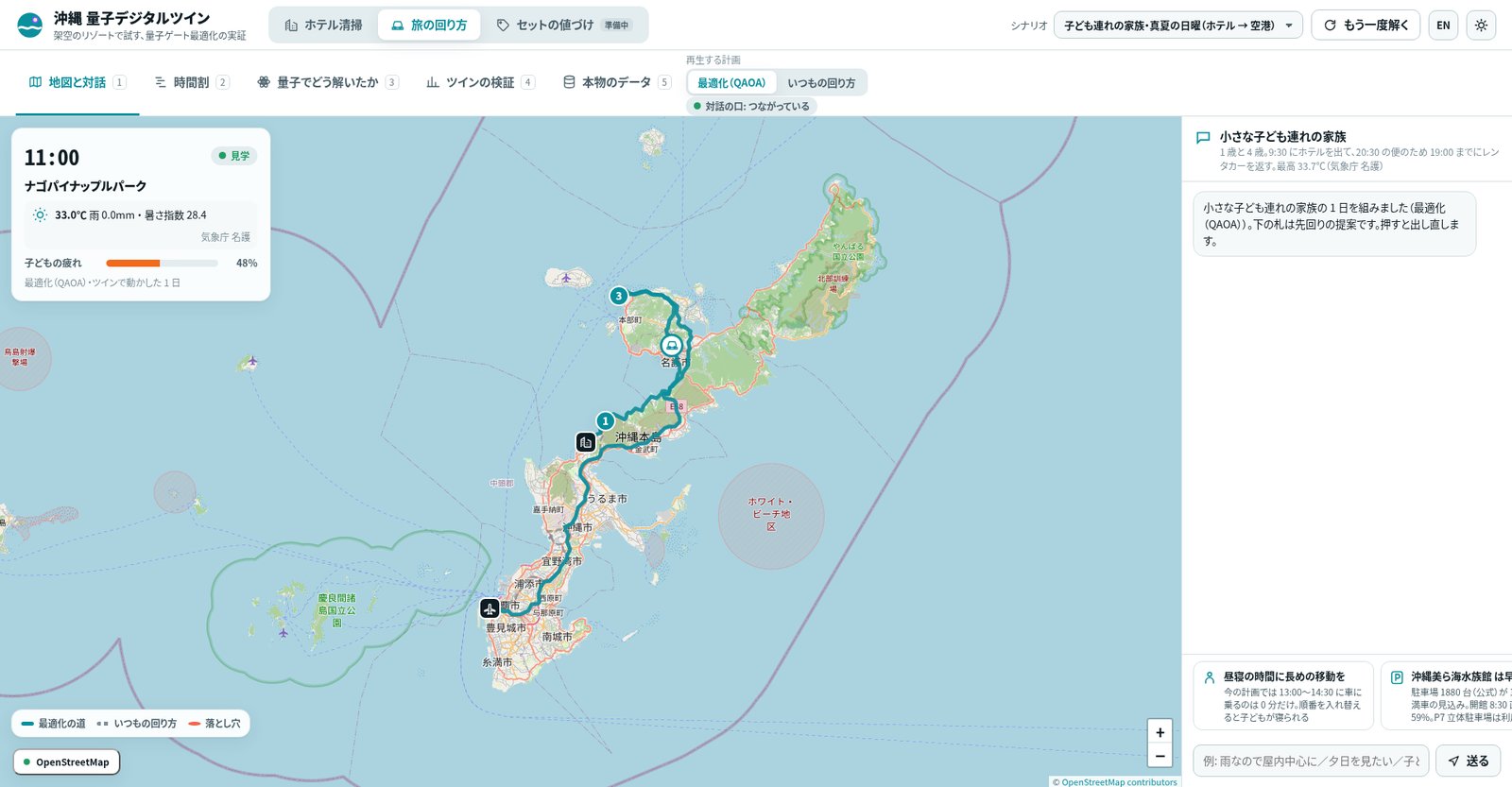
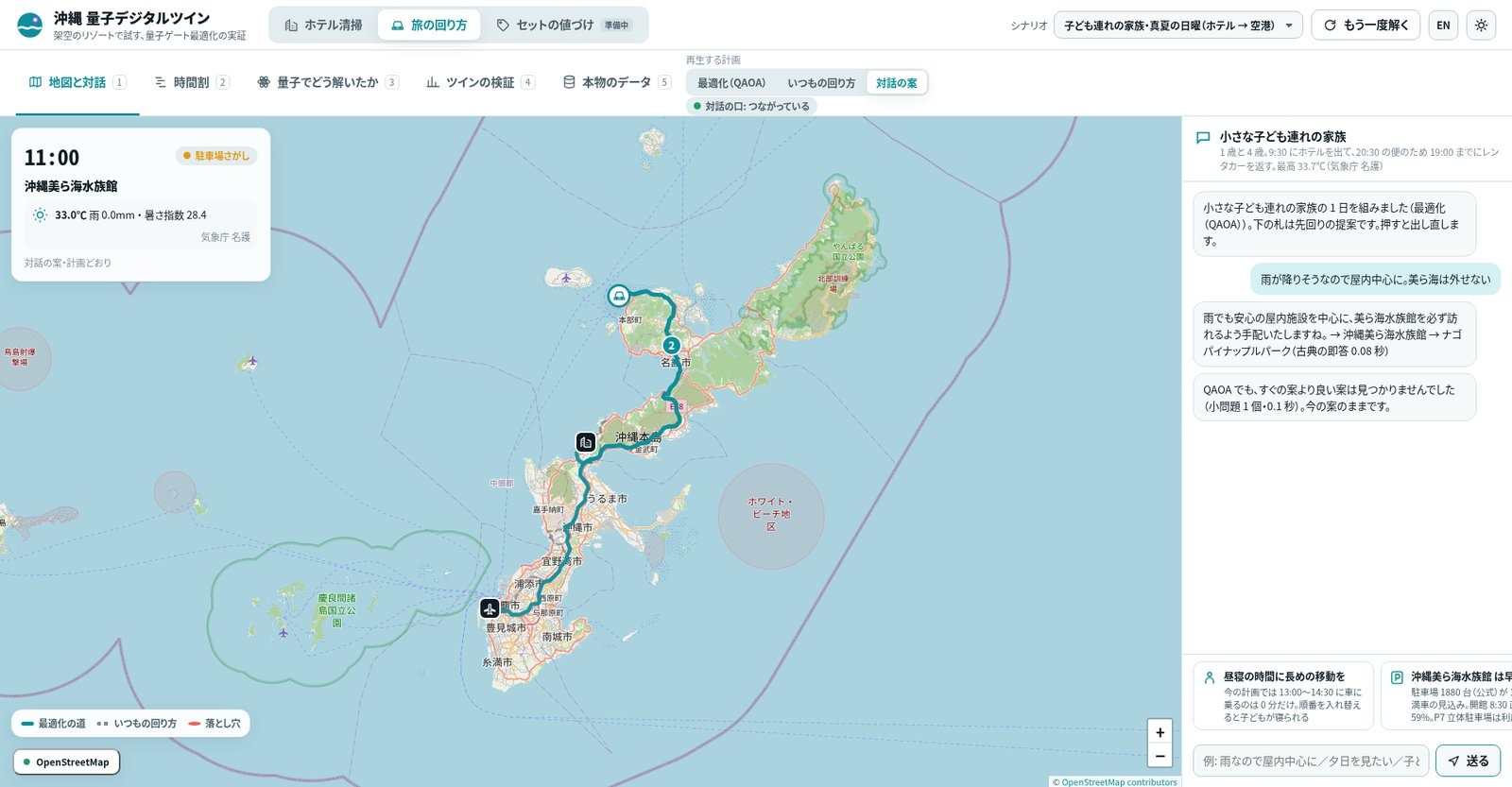
The plans also include suggestions such as scheduling longer transfers during nap times, visiting popular aquariums before parking lots fill up, and leaving ample time for airport drop-offs.
Solving Large Problems by Decomposition into Quantum Circuits
After narrowing down destination candidates to those reachable within the allotted time, an initial proposal was created using classical computing. Subsequently, “destination swapping” and “route permutation” were treated as small problems (8–14 qubits) and solved using QAOA (Quantum Approximate Optimization Algorithm), a quantum algorithm. Candidate solutions from QAOA were scored within the digital twin, and only improved solutions were selected. The QAOA used for planning was executed on a simulator that accurately calculates quantum circuit behavior.

For three out of the four groups, the resulting scores matched those of the classical simulated annealing method. The remaining group achieved 96%. This demonstrates that incorporating quantum algorithms into planning can yield answers of comparable quality to classical computing.
Results: Enjoyment Score 2.3 Times Higher, Waiting Time Halved
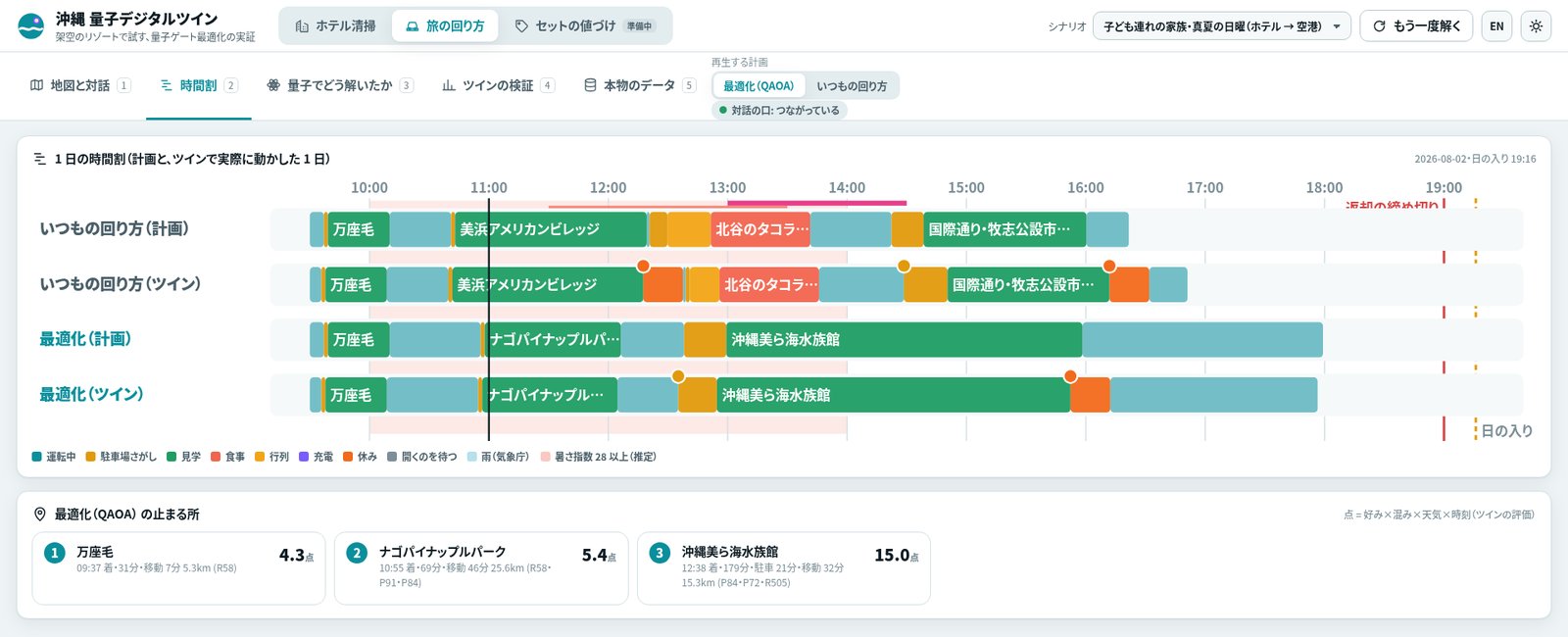
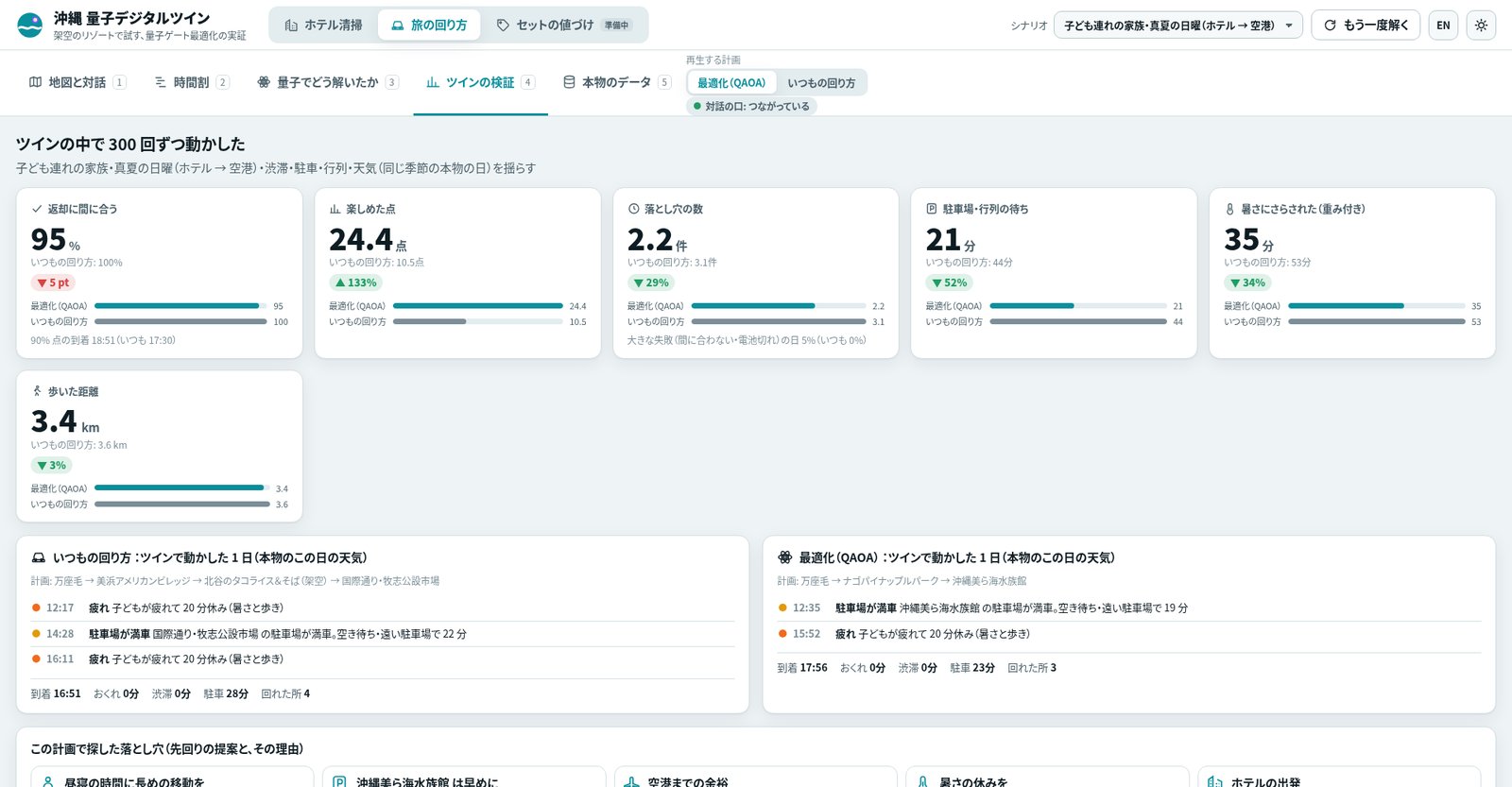
The generated plans were run 300 times in the digital twin, varying real-world weather conditions for the same season, along with fluctuations in traffic jams, parking availability, and queue formations. Compared to a typical itinerary (visiting famous spots in order of proximity), the results for a family with small children spending one summer day were as follows (averages over 300 runs):
- Enjoyment score: 10.5 → 24.4 (2.3 times)
- Waiting time for parking and queues: 44 minutes → 21 minutes
- Time exposed to heat: 53 minutes → 35 minutes
- Incidents encountered (child fatigue, full parking lots, etc.): 3.1 cases → 2.2 cases
For the elderly couple’s one-day trip, the probability of making the airport drop-off on time increased from 63% to 92%, walking distance decreased from 4.6 km to 3.3 km, and waiting time for parking reduced from 20 minutes to 10 minutes. For the EV couple, the plan incorporated charging stops to prevent running out of battery midway, which would have occurred in a typical itinerary.
Verification on Actual Quantum Hardware
Some of the small problems were also solved on actual quantum hardware (32 qubits). The settings determined by the simulator were used directly. Out of 10 small problems ranging from 5 to 9 qubits, 9 yielded answers identical to the exact solutions obtained via classical computing. The remaining problem produced nearly identical results (a ratio of 0.99 compared to the exact answer).
Note that traveler profiles, some dining options, and congestion patterns at tourist spots are assumed values and not calibrated with actual traveler data.
Using the same digital twin, a demonstration on resort room cleaning and staff shift management has also been conducted. blueqat accepts demonstration experiments starting from corporate challenges.