
blueqat conducted a demonstration to determine how to structure set meals and their prices, as well as time- and weather-based discounts for a restaurant in Chatan Town, Okinawa, using a quantum algorithm. By reproducing the movements of the shop and customers in a digital twin (a virtual representation of the real shop and people's activities) using real data such as menus from surrounding shops' official websites, price statistics, tourist numbers, traffic volume, and weather, they verified the results by running the simulation for one year with the determined menu. In the twin, annual profit increased to 1.85 times that of the current menu, and discarded food ingredients were reduced by 40%. The answer solved by the quantum algorithm was identical to the exhaustive search result of classical computation.
The setting is a fictional shop "Chatan Churateeda Shokudo"
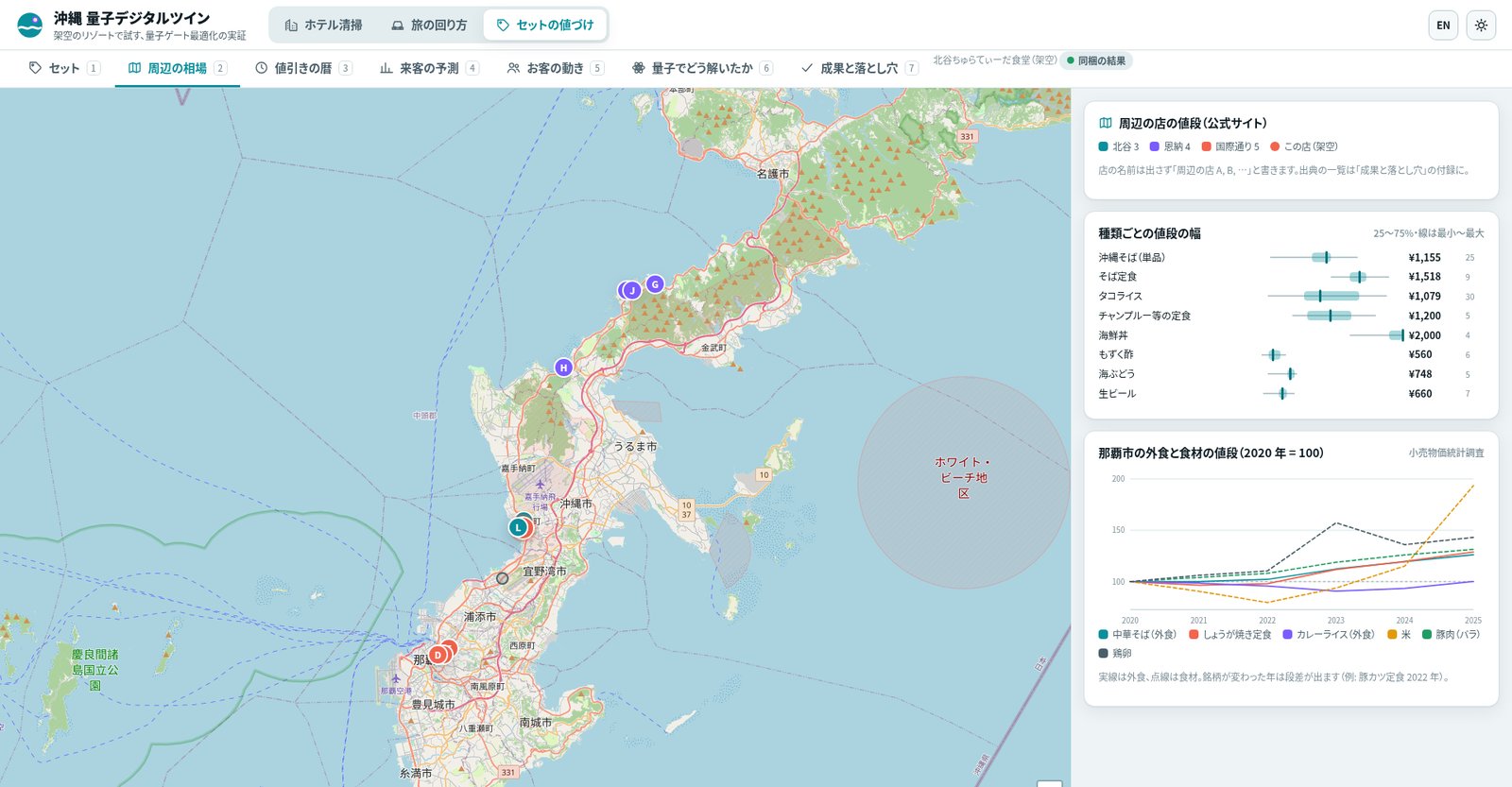
The setting is a fictional dining hall called "Chatan Churateeda Shokudo," located in Minami, Chatan Town. With 40 seats, it determines the number of kitchen and floor staff for four time slots: lunch 11:00–14:00, afternoon 14:00–17:00, dinner 17:00–20:00, and pre-closing 20:00–21:00. Customers are categorized into five types: domestic tourists, international tourists, locals, regulars, and families/groups.
The data underlying prices and customer footfall consists of actual public data.
- Price benchmarks of surrounding shops: Menus from the official websites of 12 shops around Chatan, Onna, and Kokusai-dori
- Trends in ingredient and dining-out prices: Retail Price Statistics Survey by the Statistics Bureau of the Ministry of Internal Affairs and Communications (Naha City)
- Volume and origin of tourists: Okinawa Prefecture Incoming Tourist Statistics
- Weather: Hourly and daily values for Naha from the Japan Meteorological Agency
- Traffic volume on the road in front of the shop: JARTIC Open Traffic Data (National Route 58)
- Cruise ship port calls: Naha Port Management Association
The shop, menu, customer preferences, and sales figures are fictional.
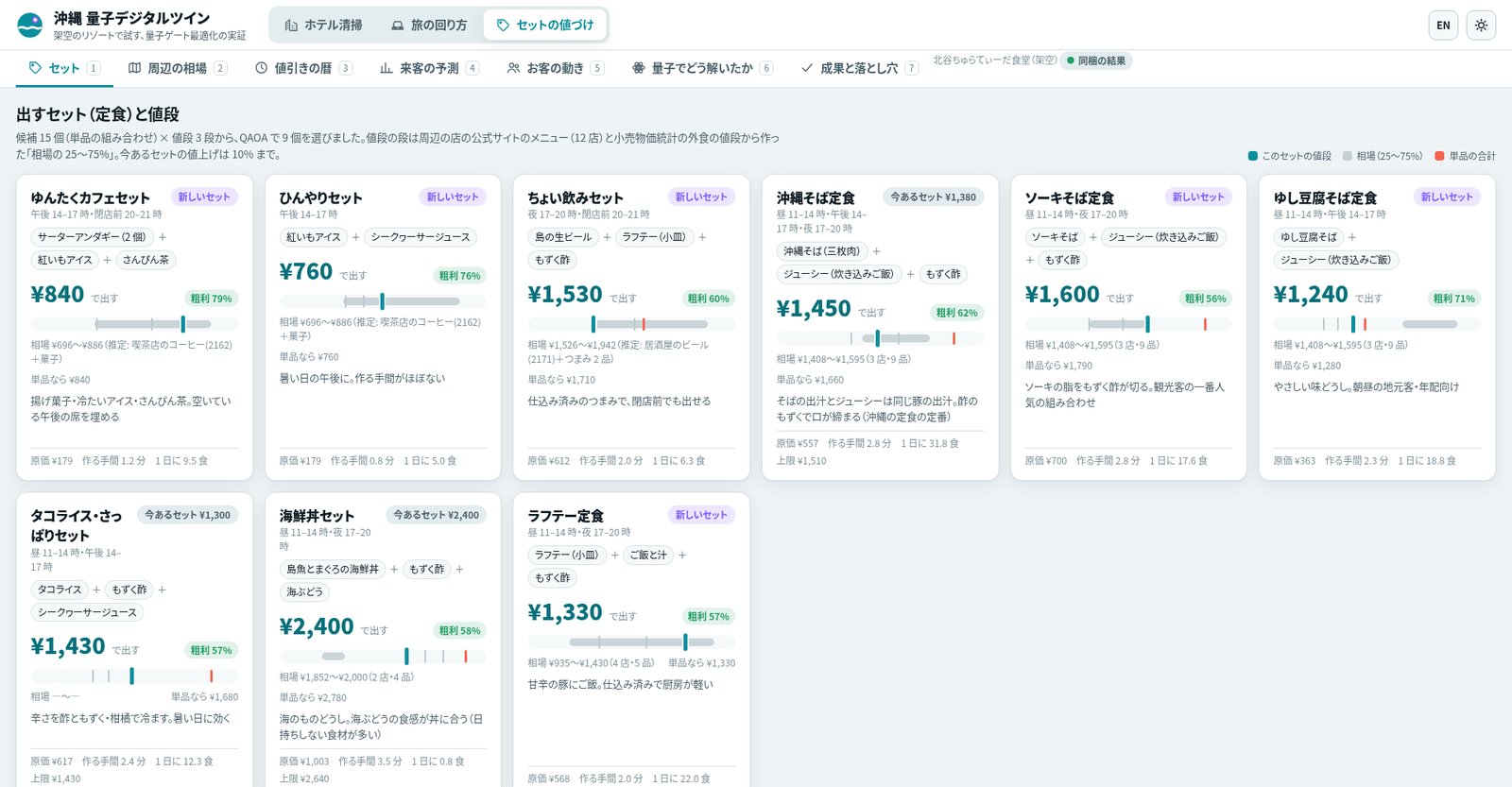
Determining set combinations and prices using a quantum algorithm
For 15 candidate sets composed of individual items, three tiers of prices are prepared to decide "which set to offer at what price." Since the combinations are too numerous as is, they are divided into three bundles (each comprising 15 qubits): lunch noodles, lunch rice dishes, and dinner/cafe items, and solved using the QAOA (Quantum Approximate Optimization Algorithm), a quantum algorithm. Factors measured in the twin, such as cannibalization and synergy between sets, kitchen workload, and reuse of ingredients, are incorporated into the problem. The QAOA used for planning was executed on a simulator that accurately calculates quantum circuit operations.

The expected daily value of the menu determined by QAOA was the same as the answer obtained by finding the best option for each bundle via exhaustive search in classical computation.
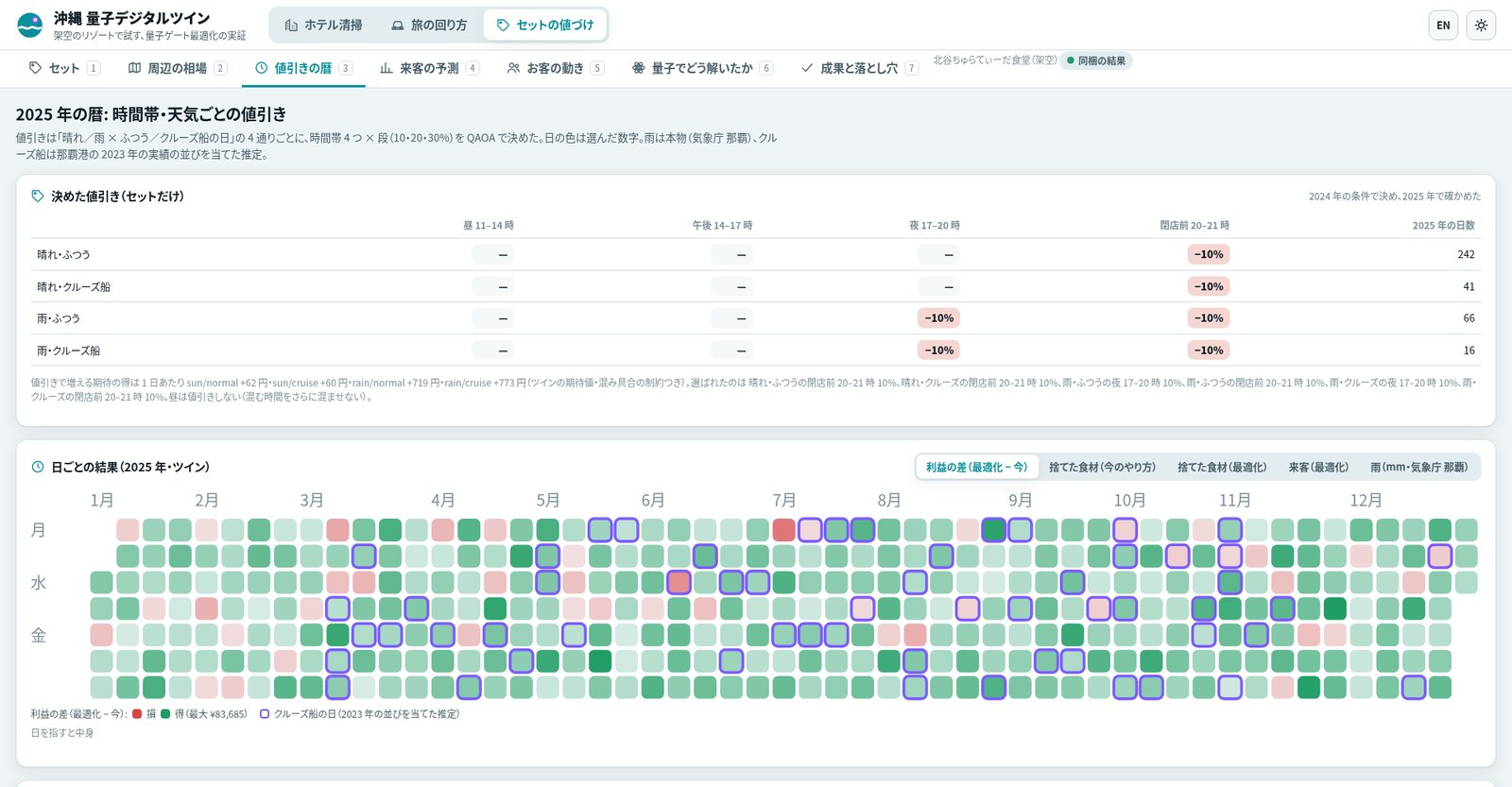
Discounts were also solved similarly. Discounts are determined for four scenarios based on whether it is sunny or rainy, and whether cruise ships arrive, specifying the percentage discount for each time slot. The answer was "10% off during pre-closing hours and on rainy nights; no discounts during busy lunch hours to avoid further congestion."
Among these, six problems (four to five qubits for smaller scaled-down problems and 15 qubits for the bundles) were also solved on an actual quantum computer (32 qubits). For all six, the actual machine yielded answers identical to the exact solutions of classical computation.
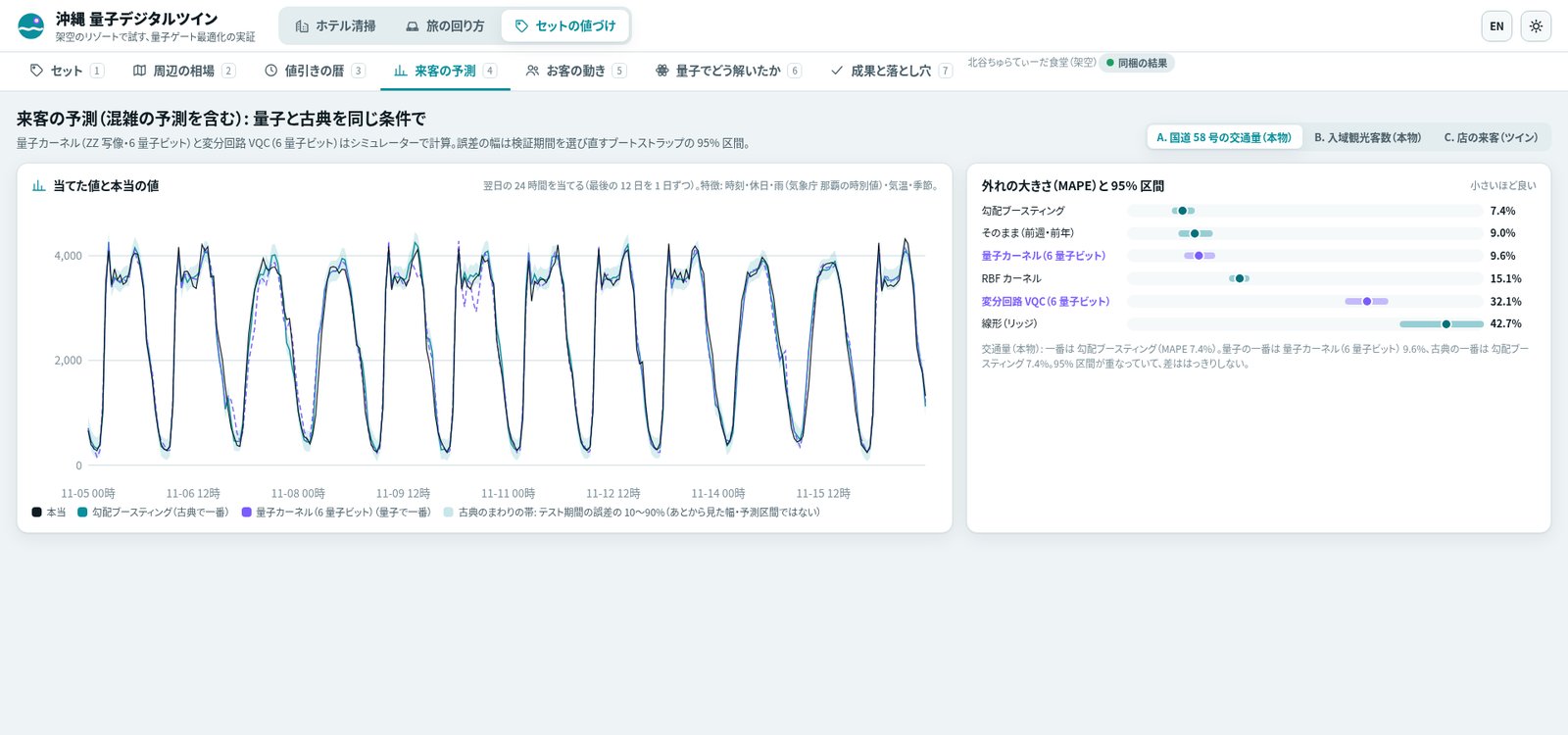
Comparing customer prediction using quantum and classical methods
To determine purchase quantities, the twin predicted customer visits. The error rate of quantum machine learning (variational quantum circuits, 6 qubits) was 11.9%, which was nearly identical to the accuracy of the best classical method (gradient boosting) at 11.8%.
Results: Profit 1.85 times higher, discarded food reduced by 40%
Menus and discounts were determined based on 2024 conditions, and the twin was run for one year under 2025’s actual weather and tourist numbers (verified by varying random seeds five times). Compared to the current menu (fixed three sets), the results were as follows (example of one year run with the same random seed; average over five different random seeds shows profit of 20.54 million yen).
- Annual profit: 11.29 million yen → 20.85 million yen
- Number of customers: 62,990 people → 69,765 people
- Discarded food: 760,000 yen → 460,000 yen
- Regulars at year-end: 192 people → 198 people
- Days when kitchen became overwhelmed: 32 days → 25 days
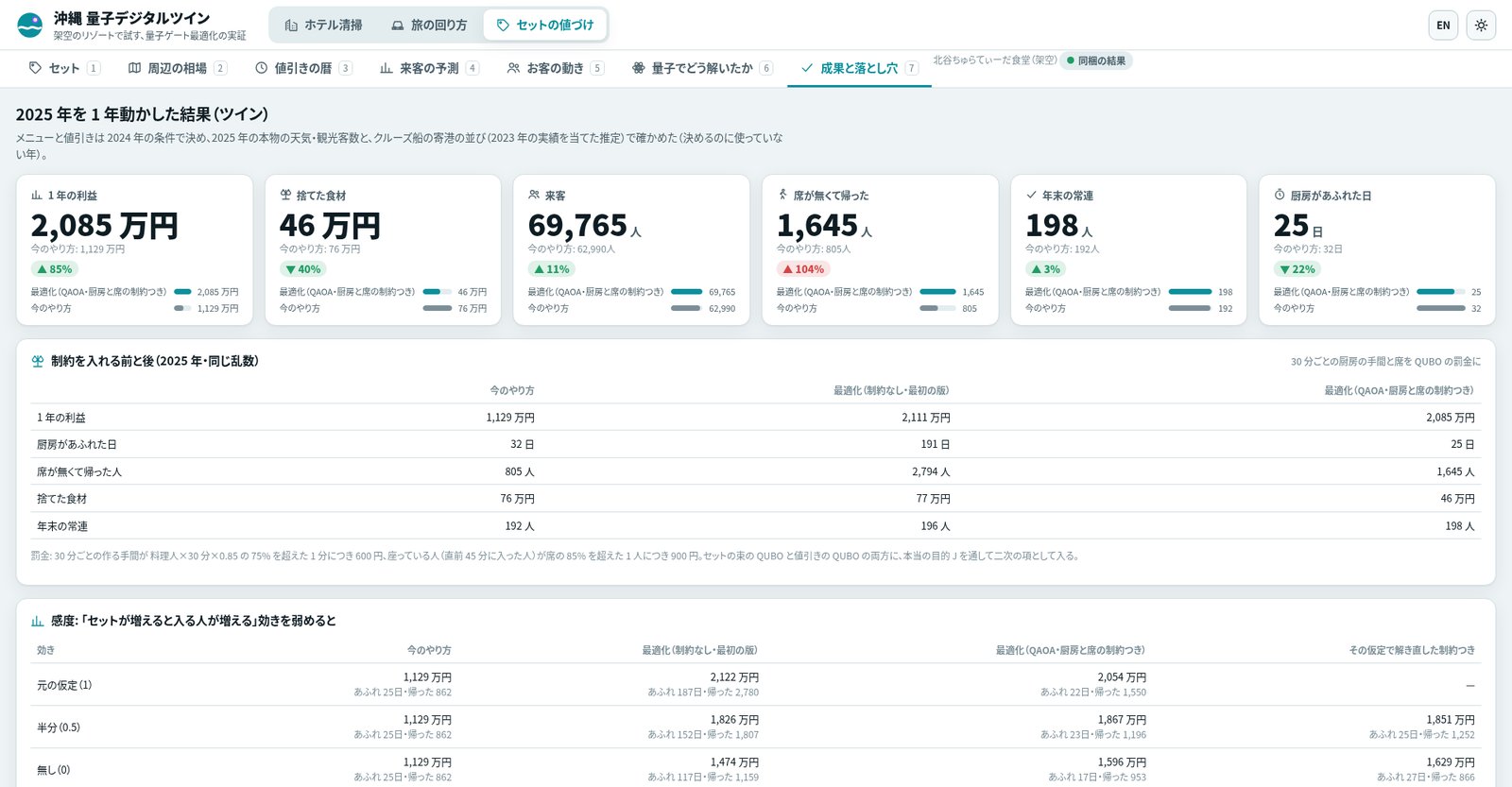
The twin also revealed pitfalls. Raising prices uniformly by 12% to offset rising ingredient costs would increase annual profit by only 310,000 yen and cause regulars to leave. The conclusion was that keeping the price of Okinawa soba set meals, which regulars frequently order, unchanged while absorbing cost increases through new set combinations is better. On rainy days, adjusting only the procurement of perishable ingredients based on next-day rain forecasts in customer predictions reduces unsold stock.
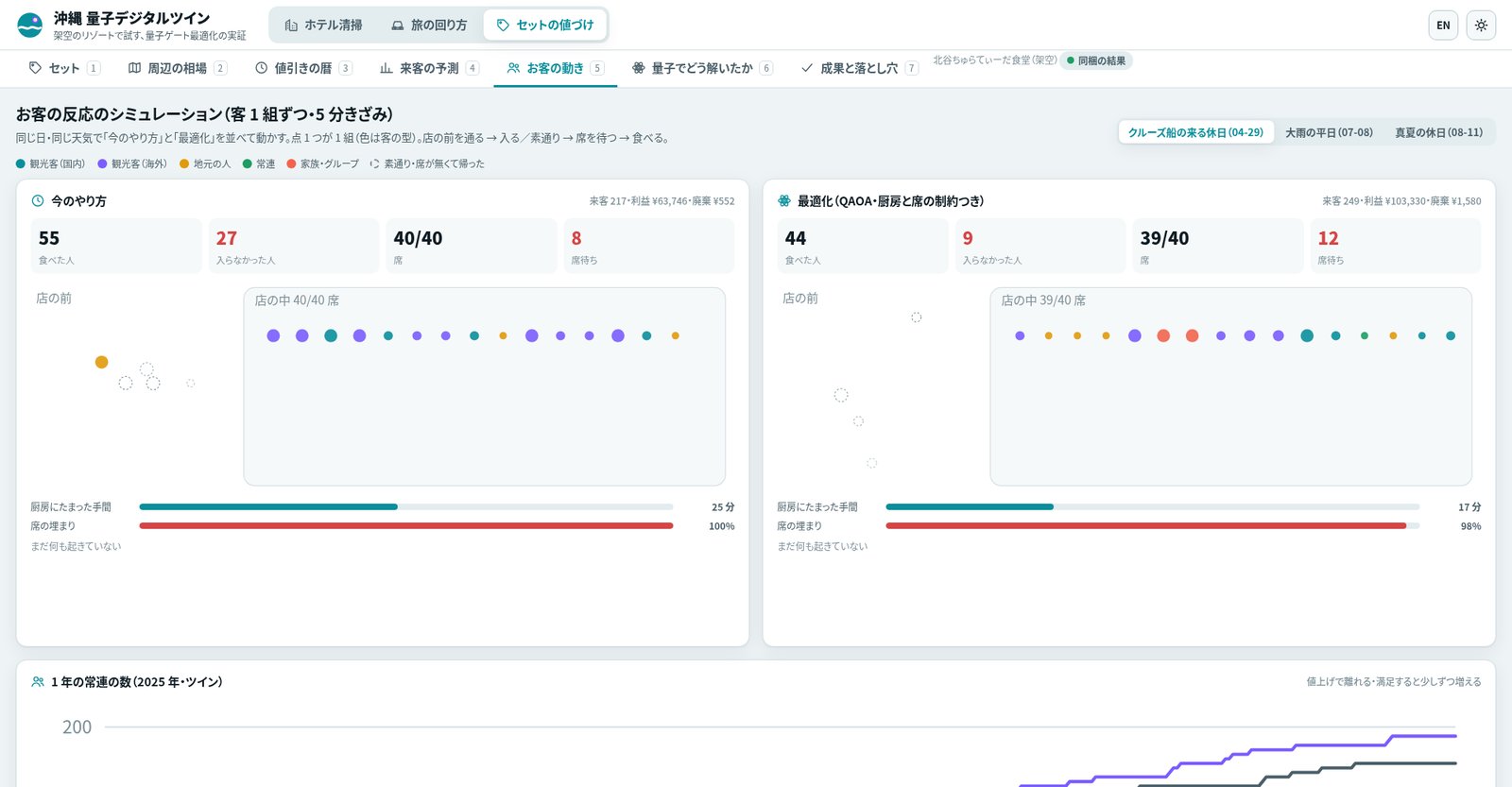
Note that the profit growth assumes that "increasing the number of sets makes it easier for people passing by to enter," which is a twin assumption rather than a value derived from real shop data.
In another Okinawa digital twin demonstration, resort room cleaning and shift scheduling has also been conducted. blueqat accepts demonstration experiments starting from corporate challenges.